Diagnosis and imaging establish what is wrong; treatment planning determines what happens next. Artificial intelligence is reshaping this critical transition by converting uncertainty into probabilistic forecasts. Through predictive modeling, simulation, and emerging quantum-enhanced optimisation, AI enables clinicians and health systems to compare therapeutic pathways, quantify individualized risk–benefit tradeoffs, and support shared decision-making. Realising this promise, however, depends on rigorous validation, transparent governance, and sustained clinical trust.
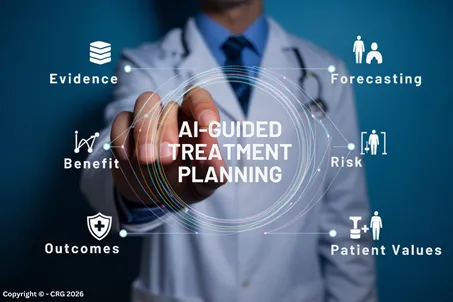
The arc of clinical care does not end with diagnosis. In many respects, it only begins there. Treatment planning represents the most consequential phase of medical decision-making, where uncertainty converges with responsibility. Which therapy should be chosen? When should it be initiated? How aggressive should it be? What risks are acceptable, and for whom?
Traditionally, these decisions have relied on population-level evidence, clinical guidelines, and physician experience. While indispensable, those tools are inherently limited. Clinical trials describe averages. Guidelines assume typical patients. Experience, however deep, cannot fully account for the combinatorial complexity of modern care, where therapies interact with comorbidities, genetics, physiology, and social context.
Artificial intelligence (AI) is now altering this landscape. By shifting treatment planning from static rules to dynamic forecasting, AI transforms uncertainty from an obstacle into a quantifiable variable.
At its core, treatment planning is a forecasting exercise. Clinicians ask a series of forward-looking questions: What is likely to happen if this therapy is chosen? How does that compare to an alternative? How will outcomes evolve over time?
AI excels in this domain because it is fundamentally probabilistic. Machine-learning models do not offer a single answer; they generate distributions of possible outcomes, each weighted by likelihood. This enables clinicians to move beyond binary thinking toward scenario analysis.
In oncology, predictive models integrate tumor genomics, prior treatment response, imaging-derived features, and patient performance status to forecast progression-free survival under different regimens. Rather than asking whether a drug “works,” clinicians can evaluate how well it is likely to work for a specific patient at a specific point in the disease trajectory.
In cardiovascular medicine, AI-driven risk calculators estimate the probability of stroke, myocardial infarction, or bleeding events under competing antithrombotic strategies. These tools update dynamically as patient variables change, transforming treatment planning into an adaptive process rather than a single decision point.
One of AI’s most powerful contributions to treatment planning is its ability to simulate outcomes before interventions are deployed. Predictive models trained on longitudinal data can project disease trajectories under different therapeutic choices, allowing clinicians to test strategies virtually.
In critical care, AI systems analyse real-time physiologic data to forecast deterioration, ventilator dependence, or organ failure, informing evolving treatment decisions. Adjustments to fluids, medications, or respiratory support can be modeled prospectively, supporting earlier and more targeted intervention.
In neurology, forecasting models predict recovery after acute ischemic events by integrating clinical examination findings, imaging-derived tissue viability metrics, and treatment timing. These projections guide escalation of therapy, rehabilitation planning, and resource allocation well before outcomes become clinically apparent.
For hospital leaders, aggregated forecasts extend this value beyond individual patients. They inform staffing needs, bed utilisation, and downstream resource demand, directly linking treatment planning to operational efficiency.
Every effective therapy carries risk. Treatment planning, therefore, requires not only estimating benefit but also quantifying harm. Historically, adverse effects were described qualitatively as population averages. AI enables individualised risk modeling.
Predictive algorithms estimate the probability of complications, such as drug toxicity, procedural risk, or hospital readmission, by synthesising outcomes across large datasets. These estimates evolve as new data are introduced.
In oncology, AI models predict treatment-related cardiotoxicity by integrating baseline cardiac function, cumulative drug exposure, and concurrent therapies. In surgical planning, machine-learning systems forecast postoperative complications using patient-specific profiles rather than procedure-based averages.
This reframing of risk has direct implications for quality, safety, and medico-legal matters. Decisions supported by transparent, data-driven risk estimates are more consistent, defensible, and aligned with value-based care metrics.
As treatment options multiply, complexity grows. Each additional drug, dose, or timing variable increases the number of possible therapeutic pathways. Classical computing struggles with this combinatorial explosion.
Quantum-enhanced optimisation introduces a new paradigm. By exploring large solution spaces in parallel, hybrid quantum–classical models show promise in addressing precisely the type of optimisation challenges that define modern treatment planning.
In pharmacology, quantum-inspired algorithms are being explored to model drug–drug interactions and dose optimisation across complex regimens. In oncology, they may enable rapid simulation of multi-agent treatment sequences that balance efficacy with cumulative toxicity.
This is not about replacing clinical judgment. It is about narrowing the field. Instead of confronting dozens of plausible options, clinicians may be presented with a short list of optimised strategies, each accompanied by quantified outcome forecasts.
As AI moves from experimental tools to clinical decision-support systems, validation and governance become central determinants of adoption. Forecasting models influence high-stakes therapeutic decisions; their credibility must therefore be earned, not assumed.
Clinical validation requires more than technical accuracy. Models must demonstrate consistent performance across diverse populations, care settings, and disease stages. Continuous monitoring is essential, as shifts in practice patterns, patient demographics, or therapeutic standards can degrade model performance over time.
Governance frameworks provide the institutional backbone for safe deployment. Leading health systems are establishing multidisciplinary oversight structures that include clinicians, data scientists, informaticists, ethicists, and operational leaders. These bodies define acceptable use, oversee model updates, monitor bias, and ensure alignment with regulatory and quality standards.
Trust ultimately rests with clinicians. Adoption falters when systems are opaque or intrusive. Forecasts must be interpretable, limitations must be clearly communicated, and outputs must be presented as decision support rather than directives. Transparency, feedback loops, and shared accountability are essential to embedding AI into clinical reasoning without undermining professional judgment.
For executives, governance is also a risk-management strategy. Institutions that can demonstrate responsible validation, oversight, and clinician engagement are better positioned to realise AI’s benefits while mitigating legal, ethical, and reputational exposure.
Treatment planning is where medicine becomes deeply personal. Patients differ not only biologically but philosophically. Some prioritise longevity. Others value quality of life, independence, or risk avoidance.
AI enhances shared decision-making by making tradeoffs explicit. Forecasts translate abstract risk into understandable scenarios. A patient can be informed that one therapy offers a higher probability of remission but also a greater likelihood of long-term toxicity, while another offers more modest benefit with fewer complications.
This transparency strengthens trust. Decisions are no longer perceived as opaque or paternalistic but as collaborative and evidence-informed. For administrators, this alignment reduces decisional regret, improves patient experience metrics, and supports institutional commitments to patient-centered care.
From a management perspective, AI-driven treatment planning functions as a strategic asset. Predictive forecasts allow health systems to anticipate downstream utilisation, length of stay, and post-acute care needs.
In population health management, AI models stratify patients by projected response to therapy, enabling targeted interventions for those most likely to benefit. In bundled-payment environments, forecasting tools help align clinical decisions with financial sustainability by identifying treatments that maximize outcome per resource expended.
When integrated into electronic medical records and command centers, treatment-planning AI provides real-time visibility into therapeutic trajectories across service lines, aligning clinical excellence with operational coordination.
Despite its sophistication, AI does not decide. It informs. Treatment planning remains a moral and contextual act, requiring empathy, experience, and accountability.
The most effective implementations treat AI as a decision-support partner rather than an authority. Clinicians retain control, using forecasts to challenge assumptions and explore alternatives. Administrators use aggregated insights to guide policy without constraining bedside autonomy.
Evidence increasingly shows that outcomes are best when clinicians and AI operate together, reducing unwarranted variation while preserving judgment.
The promise of artificial intelligence in medicine extends beyond understanding disease. Its true power lies in shaping action. Treatment planning is where insight becomes consequence, and data meets responsibility.
By converting uncertainty into probability, options into simulations, and tradeoffs into transparent forecasts, AI redefines how medical decisions are made. For clinicians, it offers clarity. For patients, agency. For health systems, alignment between quality, safety, and performance.
The final instalment in this series will examine how these capabilities converge into AI-driven precision medicine, where diagnosis, imaging, and treatment planning operate as a unified, anticipatory system rather than isolated steps.
NOTE: This is the Third in a series of four articles that comprehensively cover the different dimensions and the forecasted outcome of AI in medical practice.

Dr. Geyer is a seasoned neurologist with subspecialty expertise in epilepsy and sleep disorders. Currently, he is a Professor in the University of Alabama College of Community Health Sciences and Director of the Advanced Imaging Facility and MRI Research Facility for the University. He has a unique interest in the application of AI to all aspects of clinical medicine.

Dr. Qureshi is one of the most senior interventional neurologists in the United States and a widely published researcher. In addition to being a Professor at the University of Missouri, he is also the Director of the Zeenat Qureshi Stroke Institutes and the Editor-in-Chief of the Journal of Neuroimaging. He has been a collaborator in various projects studying AI in clinical medicine.
Dr. Gomez, a pioneer in vascular, critical care, and interventional neurology, has spent over four decades advancing stroke treatment and mentoring physicians. A passionate educator, he challenges conventional thinking through engaging lectures and his protean publications. As a Professor of Neurology at the University of Missouri, he continues to advance the novel applications of AI in clinical medicine.

Dr. Gong is an Associate Professor of Computer Science at The University of Alabama and the founding Director of the Alabama Center for the Advancement of Artificial Intelligence (ALAAI). A recognized leader in AI research, education, and innovation ecosystems, he has spearheaded initiatives that link advanced AI methods with pressing societal challenges, including rural healthcare resilience, environmental monitoring, and entrepreneurship education.

Paul Cox is a healthcare technology leader with deep expertise in AI/ML, bioinformatics, and software development. He has directed the research and commercialization of advanced AI models that drive data-driven healthcare innovations across medical devices, diagnostics, digital health, and microbiome therapeutics. Currently, he is CEO of Evimero and leads the bioinformatics efforts to develop next-generation tools for disease diagnostic devices, precision therapeutics, and human health optimization.