Precision medicine represents the most expansive and consequential application of artificial intelligence in healthcare. By integrating genomic, molecular, imaging, clinical, and environmental data into unified predictive models, AI enables truly individualised care. This article examines how advanced machine learning and emerging computational paradigms are transforming precision medicine from a conceptual ideal into an operational reality, while setting the stage for anticipatory, data-driven clinical decision-making across health systems.
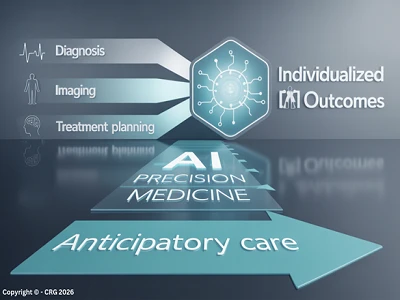
Precision medicine has long been framed as the aspiration of modern healthcare: delivering the right intervention to the right patient at the right time. Over the past two decades, extraordinary advances in data acquisition have made this goal theoretically achievable. Genomic sequencing, advanced imaging, continuous physiologic monitoring, and comprehensive electronic health records now generate unprecedented volumes of patient-specific information.
Yet the central limitation has never been data availability. Rather, it has been the inability to interpret, contextualise, and act upon that data in a clinically meaningful way. The dimensionality and interdependence of modern biomedical information exceed the limits of human cognition and traditional analytic tools. As a result, precision medicine remained more promise than practice.
Artificial intelligence fundamentally alters this constraint. Unlike conventional analytic approaches that evaluate variables in isolation, AI systems are designed to synthesise heterogeneous data streams into cohesive, predictive representations of disease and therapeutic response. Machine learning models excel at detecting nonlinear relationships, latent patterns, and higher-order interactions that are invisible to rule-based or statistically linear methods.
In this role, AI functions as the integrative engine of precision medicine. It does not replace clinical reasoning but extends it, transforming fragmented data into unified forecasts that support individualised care decisions. The shift is not incremental. It represents a structural change in how medical knowledge is constructed and applied.
Early visions of precision medicine focused heavily on genomics. While genetic information remains foundational, AI-driven precision medicine extends far beyond molecular profiling alone. Contemporary models stratify patients using a multidimensional framework that incorporates prior treatment exposure, immune status, imaging-derived phenotypes, environmental influences, and social determinants of health.
Oncology provides a clear example. AI platforms now distinguish patients with genetically similar tumors but divergent treatment responses based on contextual factors that would otherwise remain unrecognised. These insights allow clinicians to anticipate therapeutic efficacy, toxicity risk, and disease resistance patterns with greater accuracy, moving care away from protocol-driven averages toward individualised trajectories.
The true power of AI-enabled precision medicine lies in its ability to forecast rather than merely classify. Predictive models estimate disease progression, recovery potential, and complication risk before these outcomes become clinically apparent. This anticipatory capability enables earlier intervention, more deliberate sequencing of therapies, and better alignment between treatment intensity and patient-specific risk.
In cardiovascular and neurologic care, such forecasting has direct operational relevance. Models integrating physiologic trends, imaging biomarkers, and longitudinal clinical data can identify patients likely to deteriorate or fail standard therapies. For clinicians, this supports proactive decision-making. For health system leaders, it informs capacity planning, resource utilisation, and population-level risk management.
As precision medicine models grow in complexity, so do their computational demands. Classical computing architecture struggles with the combinatorial explosion created by millions of interacting biological, clinical, and environmental variables. Optimisation problems central to individualised care rapidly become intractable at scale.
This challenge has driven interest in advanced computational paradigms, including quantum-inspired optimisation, neuromorphic processing, and massively parallel architectures. These approaches promise to evaluate vast solution spaces simultaneously, accelerating simulations that would otherwise require prohibitive time and energy. While still emerging, such technologies may represent the catalyst that allows precision medicine to operate in real time across entire health systems.
Precision medicine is not solely a scientific or technical endeavor. Its success depends on governance, validation, and workflow integration. Predictive models must perform reliably across diverse populations, adapt to evolving clinical practices, and communicate uncertainty transparently. Without these safeguards, even the most sophisticated systems risk erosion of clinician trust.
Organisations leading in this space recognise that precision medicine is both a clinical capability and an enterprise responsibility. Effective deployment requires multidisciplinary oversight, continuous model monitoring, and alignment with existing care pathways. When implemented thoughtfully, AI becomes an embedded decision-support partner rather than a disruptive overlay.
Beyond individual patient care, AI-enabled precision medicine offers strategic advantages for healthcare organisations. By reducing unwarranted variation, improving outcome predictability, and supporting value-based care initiatives, it aligns clinical excellence with financial sustainability. Transparent risk forecasts also enhance shared decision-making, strengthening patient engagement and satisfaction.
In this sense, precision medicine becomes a unifying framework. It bridges clinical innovation and administrative leadership, linking individualised care delivery with system-level performance metrics.
A 62-year-old woman with diabetes, hypertension, and newly diagnosed breast cancer presents for treatment planning. Her tumor genomics reveal a mutation associated with targeted therapy response, but her prior exposure to cardiotoxic chemotherapy and subtle imaging evidence of reduced cardiac strain complicate the decision. Rather than relying solely on guideline averages, the institution’s AI-enabled precision platform integrates her genomic profile, longitudinal imaging data, laboratory trends, medication history, and population-level outcome models. Within minutes, it generates individualised forecasts comparing therapeutic pathways, estimating not only oncologic remission probability but also projected cardiac risk and long-term functional outcomes.
The care team reviews these projections during a multidisciplinary conference. The oncologist weighs the higher remission probability of a more aggressive regimen against the quantified increase in cardiac toxicity risk. The cardiologist reviews AI-derived imaging analytics suggesting early myocardial vulnerability. Together with the patient, they select a modified therapeutic sequence supported by predictive modeling and close physiologic monitoring. For the hospital, the system simultaneously flags this patient for proactive cardiology follow-up and allocates infusion resources based on predicted treatment tolerance. In this single encounter, diagnosis, imaging interpretation, and treatment forecasting converge into a unified precision framework, translating data synthesis into actionable care.
Across this four-part series, artificial intelligence has been examined not as a single technology, but as an evolving clinical partner whose impact unfolds across the full continuum of care. The first article, which focused on clinical diagnosis, established AI’s foundational role in reducing error by parsing vast streams of structured and unstructured data, transforming information overload into probabilistic clarity. Diagnosis, traditionally one of the most human and fallible acts in medicine, emerged as the first domain where cognitive augmentation delivers immediate and measurable value.
The second article turned to imaging, where AI’s strengths become visually and operationally explicit. By accelerating interpretation, standardising quantification, and integrating imaging findings with clinical and molecular data, AI demonstrated its capacity to enhance speed without sacrificing precision. Imaging served as a proving ground, illustrating how human expertise and machine intelligence outperform either alone when deployed as collaborative systems.
The third article addressed treatment planning and risk–benefit forecasting, the point at which knowledge must translate into action. Here, AI’s value extended beyond recognition to simulation. Predictive models enabled clinicians to explore therapeutic scenarios, quantify uncertainty, and align interventions with patient-specific risks and goals. Treatment planning highlighted AI’s role not as a prescriptive authority, but as a transparent decision-support partner in shared clinical judgment.
This final article places precision medicine as the integrative culmination of those prior domains. Precision medicine does not replace diagnosis, imaging, or treatment planning. It depends on them. Its distinguishing contribution is synthesis, the ability to unify diagnostic insight, imaging phenotypes, and therapeutic forecasting into a single anticipatory framework. In this sense, precision medicine represents not a parallel application of AI, but the logical convergence of the series’ preceding themes.
Underlying all four domains is a common constraint and a common opportunity: computation. Classical computing has enabled today’s advances, but the growing complexity of individualised care increasingly strains its limits. Emerging architectures, including quantum-inspired optimisation, neuromorphic processing, and massively parallel systems, may provide the computational leverage required for AI to function reliably and continuously at enterprise scale. Without such advances, AI risks remaining confined to pilot programs rather than becoming a pervasive clinical partner.
The future of medicine, as this series suggests, is neither human nor artificial, but collaborative and computational. Physicians will remain the custodians of context, ethics, and compassion. AI will shoulder the burden of complexity, processing the unimaginable, revealing the invisible, and forecasting the uncertain. Together, they will shape a healthcare system that is not only more efficient, but more precise, more humane, and increasingly anticipatory in its care of every patient.

Dr. Geyer is a seasoned neurologist with subspecialty expertise in epilepsy and sleep disorders. Currently, he is a Professor in the University of Alabama College of Community Health Sciences and Director of the Advanced Imaging Facility and MRI Research Facility for the University. He has a unique interest in the application of AI to all aspects of clinical medicine.
Dr. Qureshi is one of the most senior interventional neurologists in the United States and a widely published researcher. In addition to being a Professor at the University of Missouri, he is also the Director of the Zeenat Qureshi Stroke Institutes and the Editor-in-Chief of the Journal of Neuroimaging. He has been a collaborator in various projects studying AI in clinical medicine.
Dr. Gomez, a pioneer in vascular, critical care, and interventional neurology, has spent over four decades advancing stroke treatment and mentoring physicians. A passionate educator, he challenges conventional thinking through engaging lectures and his protean publications. As a Professor of Neurology at the University of Missouri, he continues to advance the novel applications of AI in clinical medicine.
Dr. Gong is an Associate Professor of Computer Science at The University of Alabama and the founding Director of the Alabama Center for the Advancement of Artificial Intelligence (ALAAI). A recognized leader in AI research, education, and innovation ecosystems, he has spearheaded initiatives that link advanced AI methods with pressing societal challenges, including rural healthcare resilience, environmental monitoring, and entrepreneurship education.

Paul Cox is a healthcare technology leader with deep expertise in AI/ML, bioinformatics, and software development. He has directed the research and commercialization of advanced AI models that drive data-driven healthcare innovations across medical devices, diagnostics, digital health, and microbiome therapeutics. Currently, he is CEO of Evimero and leads the bioinformatics efforts to develop next-generation tools for disease diagnostic devices, precision therapeutics, and human health optimization.