The Encounter as an Illusion of Completeness
I remember the moment clearly. It was a Tuesday afternoon clinic, and one of my longtime patients — a 79-year-old woman I had been managing for years — came in for her quarterly visit. She was pleasant, cooperative, and reported nothing unusual. Her vitals in the exam room were unremarkable. Three days later, she was in the emergency department with urosepsis.
When I reviewed what had happened, the physiological story was obvious in retrospect. The early signs had been there — a gradual temperature drift, a slight acceleration in resting heart rate, subtle changes in her sleep and activity patterns. But no one had been watching. Not because her care team was inattentive. Because there was no mechanism to watch.
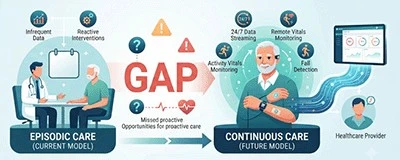
That experience crystallized something I had sensed for years but had not yet named precisely: the clinical encounter creates an illusion of completeness that does not survive contact with reality. The office visit, the quarterly nursing assessment, the transition-of-care call — these are snapshots. They record a patient's condition at a single moment and then go silent for days, weeks, or months.
The arithmetic is unforgiving. For a patient on the standard quarterly physician visit schedule, the interval between encounters runs to 89 days. Even where care teams make a deliberate effort to reach patients more frequently, what remains between contacts is measured in weeks. In every case, clinicians are making decisions based on what the patient recalls and what presents on examination, while the preceding interval has produced no continuous clinical record whatsoever.
This is not a failure of effort or intention. It is a structural limitation of episodic care models applied to a population whose health trajectories do not pause between encounters.
Why Aging Physiology Demands a Different Measurement Framework
The conventional clinical monitoring paradigm relies on population-level reference ranges — a heart rate above a threshold, a temperature exceeding a defined value, an oxygen saturation below a cutoff. These ranges were largely derived from general adult populations in acute and ambulatory care settings. Applied to elderly patients in community-based environments, they function as blunt instruments calibrated for the wrong patient.
After two decades in primary care and geriatric practice, I have watched this mismatch play out hundreds of times. The frail 83-year-old whose “normal” resting heart rate runs 58 beats per minute gets flagged for nothing when it climbs to 74 — well within population reference range, but a 27 percent increase from her personal baseline that, in my experience, almost always means something is brewing. The reference range said normal. Her body was telling a different story.
Published geriatric physiology literature documents clearly what experienced clinicians observe in practice: older adults exhibit attenuated compensatory responses, narrowed homeostatic margins, and reduced physiological reserve. The Lifelines Cohort study — with a population exceeding 153,000 participants — has contributed foundational normative data demonstrating the degree to which parameter stability and normal range interpretation must be adjusted for age.
The clinical implication is straightforward but profound. A skin temperature elevation of 0.8 degrees Celsius in a 45-year-old may be unremarkable. In a frail 82-year-old with baseline autonomic dysregulation, the same deviation from that individual's personal norm is a departure worth evaluating rather than a value worth dismissing. The signal is not absolute — it is relative. It belongs to the individual, not to a population table.
This distinction reshapes the monitoring requirement entirely. Population-level threshold alerts are not designed to surface individualized physiological departure. Only a continuous, longitudinal approach that establishes and tracks personal baselines over time can surface the early, subtle deviations that precede deterioration in this population. And a surfaced deviation is not a finding in itself — it is a prompt for clinical assessment by the people qualified to make one. Episodic encounters cannot provide that prompt, not because clinicians are not trying, but because the framework was never designed for it.
What Deploying This Technology in the Real World Actually Looks Like
A word on where this work began, because it explains the design choices that follow. The platform I have spent the past several years developing was built for maritime and remote-work environments — crews operating for weeks at a stretch with no clinician aboard and no one positioned to notice a change. The problem in that setting is not interpretation. It is measurement: establishing what is normal for one specific individual when there is no observer present, and recognizing when that individual has moved away from it.
That turned out to be a general problem with more than one application, and readers who run hospitals and health systems will recognize it under other names. It is the patient discharged on a Thursday whose decline is invisible until she returns through the emergency department on Monday. It is the post-acute interval that decides a readmission penalty. It is the assisted living resident whose next scheduled encounter is 89 days away. Different populations, different settings, different economics — but the same structural gap, and the same measurement approach applies to each of them. Senior care is where I believe the immediate consequence is largest, which is why this article is about senior care.
We have spent considerable time working directly with assisted living operators and care organizations, and one lesson stands out above all others: the distance between a technically capable device and a deployable clinical tool is wider than most developers expect and wider than most care operators are prepared to navigate.
Older adults in assisted living are not consumer health technology users. Many are cognitively impaired to varying degrees, dependent on care staff for activities of daily living, and deeply attuned — rightly so — to any implication that their independence or privacy is being compromised. A monitoring platform that requires active patient engagement, generates anxiety, or creates new daily burdens for already stretched care staff will not achieve adoption regardless of its technical merit. We have seen this firsthand.
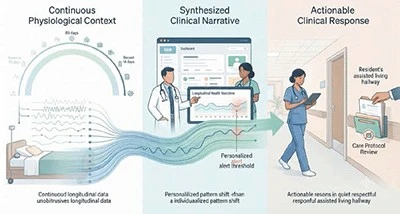
The design requirements for this population are therefore behavioral and operational before they are technical. The device must be passive and unobtrusive. Charging must be infrequent and staff-manageable. And critically, data must flow to the care team — not to the patient or family as raw parameter streams — arriving as synthesized, actionable clinical context rather than alarm floods that no one has time to interpret.
This last point is the one we find ourselves explaining most often. The value of continuous monitoring is not the generation of more data. Every care organization we speak with already has more data than they can act on. The value is the transformation of continuous physiological data into a longitudinal record that informs the care encounter. The physician arrives not asking what she can assess in 20 minutes, but briefed on 89 days of physiological context. The nursing staff receives an alert not because a parameter crossed a population threshold, but because this specific resident's individualized pattern has shifted in a way that warrants a look.
Achieving this requires workflow integration built from the start: alert thresholds mapped to clinical response protocols, documentation structured for EHR compatibility, and care staff trained not in the technology itself but in what to do when it surfaces a concern.
A Patient Who Stays With Me
The vignette I described at the opening of this article was not an isolated event. Over the years, I have sat with too many families in transition-of-care conversations — explaining what happened, what we missed, and what we might have caught earlier — to treat the monitoring gap as an acceptable feature of geriatric care.
Let me describe what that conversation looks like when continuous monitoring is present instead.
An 84-year-old woman with moderate dementia, atrial fibrillation managed on anticoagulation, and a history of recurrent urinary tract infections presents for her quarterly visit. She is pleasant and reports no complaints. Her family visited two weeks ago and noticed nothing unusual.
Under a continuous monitoring framework with individualized baseline tracking, the clinical picture arriving with her is different. Over the preceding three weeks, there has been a gradual 0.6-degree upward drift in her nocturnal skin temperature from her established personal baseline, accompanied by a subtle but consistent elevation in resting heart rate and a mild reduction in overnight movement variability. None of these findings would individually cross a population-level alert threshold. In aggregate, they represent a clear departure from her longitudinal norm — the kind of shift that, in this population, commonly precedes a clinical change by five to seven days.
The physician, briefed on this trend before entering the room, asks targeted questions and orders a urinalysis. The evaluation happens days earlier than it otherwise would have, and treatment begins accordingly. The hospitalization that would have followed an unwitnessed deterioration does not occur. The family, rather than receiving a distressed phone call from the nursing station at 2 a.m., gets a routine update at the next visit.
Nothing in that sequence was decided by a device. The monitoring did one thing: it told a clinician where to look, days before anyone would otherwise have looked. Every judgment that followed was hers.
That is the briefed visit. It is not a technology story. It is a care story made possible by infrastructure that finally matches the clinical reality of how elderly people age.
The Operational and Quality Case
Assisted living operators are measured on hospitalizations, emergency department transfers, resident satisfaction, and regulatory survey performance. Each avoided hospitalization has direct cost implications and reputational value. A monitoring program that demonstrably reduces avoidable acute care events is not a cost center — it is a performance driver, and increasingly, a competitive differentiator as families become more sophisticated consumers of senior care.
The operational framing in this section reflects work with my co-author, Silvana Fischman, whose experience in value-based care operations, risk adjustment, and performance improvement shaped how we came to think about the distance between a monitoring capability and a care organization able to absorb it. The technical case for continuous monitoring is the easy part. The operational case — who receives the alert, what they are expected to do about it, and how that obligation fits inside an already full shift — is where these programs succeed or fail.
For risk-bearing care organizations and accountable care structures, the alignment is even more direct. Avoidable hospitalizations represent both a quality failure and a financial loss. Risk adjustment accuracy — the ability to appropriately characterize patient acuity for prospective payment — depends on longitudinal clinical documentation that episodic encounters alone cannot fully support. Continuous physiological monitoring generates that longitudinal record, improving both care quality and the clinical documentation that supports accurate contract performance.
The infrastructure for this alignment exists. What the industry now requires is the operational will to close the gap between monitoring capability and deployed clinical reality — and the leadership vision to recognize that continuous monitoring in aging populations is not a technology initiative. It is a care delivery redesign.
The 89 Days Belong to the Patient
The 89-day gap between clinical encounters is not a scheduling artifact or an administrative inconvenience. It is the actual duration of the senior patient's health experience between the moments when any clinician is paying attention. It is where most deterioration begins, where most preventable hospitalizations originate, and where the earliest opportunities for intervention are routinely missed — not because clinicians do not care, but because no monitoring infrastructure exists to surface what is happening.
The geriatric physiology literature has documented why population thresholds fail this population. Clinical experience in senior care has made the consequences of unmonitored intervals concrete and repeatedly painful. The technology to support continuous, individualized wearable monitoring has matured. The quality and outcomes incentive structures are in place.
What remains is the deployment gap — the organizational, operational, and workflow infrastructure required to translate technical capability into clinical routine. That gap is closeable. And for the patients who live inside those 89 days, it matters enormously that we close it.
References
1. Lifelines Cohort Study. University of Groningen. https://www.lifelines.nl. Accessed June 2026.
2. Rockwood K, Mitnitski A. Frailty in relation to the accumulation of deficits. J Gerontol A Biol Sci Med Sci. 2007;62(7):722-727.
3. Inouye SK, Studenski S, Tinetti ME, Kuchel GA. Geriatric syndromes: clinical, research, and policy implications of a core geriatric concept. J Am Geriatr Soc. 2007;55(5):780-791.
4. Tinetti ME, Fried TR, Boyd CM. Designing health care for the most common chronic condition — multimorbidity. JAMA. 2012;307(23):2493-2494.
5. Sligl W, Taylor G, Majumdar SR. Vital signs, bacteremia, and severity of illness in nursing home-acquired pneumonia. J Crit Care. 2006;21(1):22-27.
6. Creditor MC. Hazards of hospitalization of the elderly. Ann Intern Med. 1993;118(3):219-223.
7. Strandkjaer M, Hansen CS, Jensen MT, et al. Reference intervals for wearable sensor-based resting heart rate variability measures by age and sex. J Am Heart Assoc. 2022;11(12):e024390.
8. Centers for Medicare & Medicaid Services. Medicare Advantage Quality Bonus Program. CMS.gov. 2025.