
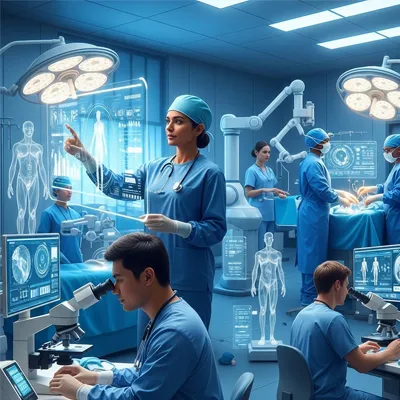
Orthopedic surgery is no longer characterized by conventional joint replacement and corrective surgeries only but is becoming technologically advanced. Worldwide orthopedic devices industry generated a revenue of over USD 40 billion in 2023 and looks to grow tremendously in the next 10 years attributed to aging patients, the surging sports injuries, and the development in the demand of minimally invasive medical tools. However, what distinguishes the present era is the interplay of all these three elements, i.e. advanced materials, digital health technologies, and surgical robotics, and redefines the future of orthopedics.
To the business to business fraternity, this evolution is not just a clinical revolution- it is a commercial revolution. As the hospitals become focused on finding value-based care solutions, device manufacturers are increasingly under pressure to provide not just devices but complete solutions that achieve better outcomes, decrease surgical time, and decrease healthcare expenditures. The new technologies and tools in orthopedic surgery are promising areas that partnership, investment, and new business models can be established to characterize the future management of the healing process.
Smart Implants: Beyond Replacement to Real-Time Insights
Smart implants are one of the most prominent innovations in the sphere of orthopedic surgery.
Unlike conventional orthopedic implants, where every implant has a strictly mechanical purpose, smart implants will be fitted with sensors to log information on, e.g., load distribution, healing progresses and implant performance in real-time. Such implants give clinicians an opportunity to observe patients remotely, to timely engage earlier in case of complications, and personalize rehabilitation plans.
Smart implants provide long-term value to manufacturers that have the potential of value creation using data-driven healthcare approaches. The hospitals and insurers have the advantage of fewer revision surgeries whereas technology companies have the opportunity to indulge in data analytics platform to supplement the hardware solutions. In B2B terms, transformation of products-focused business models to service ecosystems is a massive growth trend.
Robotics and AI: Precision Redefined
Robotics over the past few years has gained momentum in orthopedic surgery, especially in joint replacements and in the spine. The precision of alignment and positioning of the implants is also unrivaled in robotic platforms that directly correspond to improved patient results and extended implant durability. Artificial intelligence enhances robotics by providing predictive surgeon planning, intra-operative decision support and analytics.
The combination of the robotics and AI is also not only modifying the quality of surgeries but is also transforming procurement choice in the hospitals. The possession of highly modern robotic systems is becoming a requirement of the surgeons and hospitals are investing in them with a view to creating a competitive stance. This will establish an ecosystem in which device manufacturers, AI software creators and surgical training organizations work together to provide end-to end solutions. Strategic partnership between robot companies and hospitals will prove to be the foundation of the future growth of B2B players.
Regenerative Medicine: Healing Beyond Hardware
The past major orthopedic surgery has aimed to restore damaged tissue by either repair or substitute of the damaged tissue with a mechanical device. Regenerative medicine is however changing the paradigm by attempting to treat to restoration of natural function which is achieved using biologics, stem cell treatments and tissue engineering. With improvements on 3D-printed scaffolding, growth factors, as well as cell based therapies, there will be a move away from invasive therapy towards more personified treatment.
Though these treatments are still at different stages of clinical adoption, it is an incredibly big growth market in the corporate biotechnology market, the orthopedics implant manufacturing industry and healthcare. The partnerships of biopharma companies with orthopedic centers are giving birth to new B2B opportunities in the research and clinical trials as well as the commercialization channels. Biologics are likely to see a 'mating' with conventional orthopedic implants to yield hybrid solutions that will combine mechanical support with biological healing.
Minimally Invasive Techniques: Smaller Incisions, Greater Business Potential
Current patients are more demanding of procedures used that reduce their pain, recovery and hospital stays. The demand is also met by minimally invasive orthopedic procedures; such as arthroscopies as well as endoscopic joint surgery, and percutaneous spinal surgery. In the case of hospitals, the patient hospital days and operation costs are minimized through these methods, which is in line with value-based care efforts.
Specialty instruments and visualization systems/surgical navigation technologies supporting minimally invasive procedures are also a B2B growth opportunity. To aid these techniques, device manufacturers are being creative in developing tools that are ergonomically designed and also enhance visualization. In the meantime, the training and education markets also tend to grow, so, parallel business opportunities open up when it comes to simulation technologies and virtual surgical training systems.
Digital Health Integration: Orthopedics in the Connected Era
Digital health has seeped into just about every nook and cranny of healthcare and orthopedics is no stranger. Tele-rehabilitation, remote monitoring, wearable devices and AI-based-rehabilitation platforms are allowing individualized care well beyond the operating room. Digital tools improve patient experience, monitor their progress daily, and enable caregivers to shift the treatment regimen on the fly.
On a B2B perspective, this integration presents opportunities in the form of partnership between orthopedic device companies and software developers as well as telehealth vendors. The concept is moving to ecosystems connected solutions rather than standalone devices to provide continuity of care. The firms that have managed to integrate digital frameworks and surgical solutions will have competitive advantages in a market where the overall patient outcomes are more valued.
3D Printing: Personalized Orthopedics at Scale
Orthopedic surgery is one application of 3D printing that is change the landscape by providing patient-specific implants and skeletal models. Custom- made implants minimize complications, they fit well and their recovery periods are faster. Surgery scheduling is also getting advantages of the 3D models printed such that the surgeons would be able to practice on complex issues before entering the operating room.
Among B2B entities, there are market opportunities in terms of design software, material e-innovation, and on-demand manufacturing services. Hospitals are looking at point-of-cares 3D printing laboratories and device companies are increasing products that furbish manufactured, to-order implants. Alliances with logistic firms to deliver 3D-printed devices just-in-time is another sign of how supply chains are evolving to serve the age of personalization.
Global Market Dynamics and B2B Implications
Huge growth is anticipated in the orthopedic device market and especially in the emerging markets because of the fast-paced changing nature of the health care infrastructure. The developed world is aging, and in addition to the population growth, the demand in the advanced or super joint replacements will be propelling forward, as well as sports medicine and trauma care are gaining ground globally. There is however a growing competitive environment and this means that B2B players have to be innovative, through alliances and new service models.
Hospital procurement is moving more in the direction of integrated value propositions as opposed to stand alone devices. The ability of companies to provide bundled solutions, i.e. implants, robotics, training and the post-surgical monitoring, will set them on a very strong competitive position. Additionally, the data-based reimbursement models spur collaboration between the manufacturers of medical equipment, the companies providing insurance-based coverage, and digital healthcare companies so as to maximize patient outcomes whilst keeping expenses in check.
Challenges on the Horizon
The future of the orthopedic surgery is faced with heavy challenges despite the presented opportunities. The regulatory compliance of new devices and biologics is complicated and cumbersome. Superior costs related to robotics and intelligent implants can inhibit uptake into market segments that are price conscious. Issues of data privacy with regard to online-linked implants and digital platforms have to be resolved as well.
These challenges are dangers and opportunities to B2B growth. Companies that aim to incorporate the compliance needs of regulatory provisions, cost-controls as well as cybersecurity will have the capability to market share.
Moreover, surgeon education and training will have to be invested in order to have effective adoption of advanced technologies.
The Road Ahead: From Devices to Ecosystems
The future of orthopedic surgery is moving away from device-focused innovation moving to ecosystem focused solutions. The leaders of the future in the field will no longer just produce implants or robots to operate, but whole germlines to organize the balance of devices, biologics, digital health and data analytics. This transformation requires that new business models and cross-industry collaborations emerge plus a more patient-centric outcome orientation.
Long-term value creation is where B2B players are headed in the future as they start to look beyond transactional sales. A few of the ways in which companies can exploit subscription-based models of surgical robotics, data monetization approaches to smart implants, and shared research models of regenerative treatments are just the tip of the iceberg. The ones predicting and responding to these changes will not only succeed in orthopedic market but would help to design the future of surgery even out of the space of the orthopedic market.
Conclusion
The blurring process between orthopedic surgery, technology, and biology is where the future of the industry is being written. New interventions like minimally invasive techniques, 3D-printed devices and robotic systems, regenerative medicine and smart implants are replacing current systems and changing the landscape significantly. To the B2B healthcare ecosystem, it is not just a clinical journey - but an inflection point that offers continued growth, new revenue streams, and market expansion in a global economy.
Ongoing successful evolution in orthopedic surgery in this new era will require stakeholders to think outside of the device box, look at the connected ecosystem, and make patient outcomes the ultimate value measure. Regardless of whether you are a manufacturer, distributor, healthcare provider or a technology company, you should move to act now - because orthopedic innovations practiced today are already defining the healthcare markets of tomorrow.