
Cardiac surgery has undergone significant advances over the past decades, driven by improvements in surgical techniques, anesthesia, perfusion technology, and perioperative care. These developments have contributed to better patient outcomes and increased procedural safety. Nevertheless, postoperative complications such as acute kidney injury, neurological events, and prolonged intensive care stays remain important clinical challenges. At the heart of modern cardiac surgery is cardiopulmonary bypass (CPB), a complex intervention that temporarily replaces the functions of the heart and lungs while providing a stable environment for surgical repair. The success of CPB depends not only on technological capabilities but also on the ability of the perfusion team to maintain adequate tissue perfusion and oxygen delivery throughout the procedure. Traditionally, perfusion management has relied on a reactive model in which physiological parameters are continuously monitored and corrective actions are taken once deviations become apparent. The rapid digitalization of healthcare is now transforming this approach. Modern operating rooms generate large volumes of physiological and procedural data from monitoring systems, perfusion devices, laboratory analyzers, and electronic medical records. Advances in data integration, real-time analytics, and predictive modeling are enabling clinicians to anticipate physiological deterioration before it becomes clinically evident. This evolution has led to the emergence of predictive perfusion, a data-driven approach that combines continuous monitoring, advanced analytics, and clinical decision support tools to optimize patient management. By identifying early indicators of risk and guiding timely interventions, predictive perfusion has the potential to improve organ protection, enhance patient safety, and support more personalized perioperative care. This article explores the transition from reactive monitoring to predictive perfusion and its implications for the future of cardiac surgery.
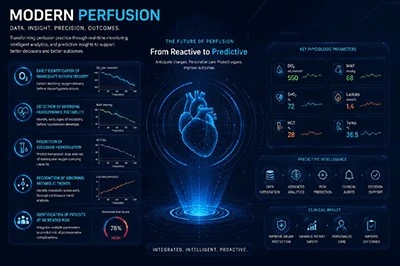
The Limitations of Traditional Reactive Monitoring
For decades, perfusion management during cardiopulmonary bypass (CPB) has relied on monitoring physiological variables such as arterial pressure, blood gases, hematocrit, temperature, pump flow, and venous oxygen saturation. While these parameters remain essential for patient safety, traditional monitoring is largely reactive, with interventions typically initiated only after measurable physiological changes have occurred. This approach presents important limitations, particularly in complex cardiac procedures where physiological deterioration may begin at the cellular and microcirculatory level long before it becomes evident through conventional monitoring. As a result, clinicians may recognize signs of compromise only after tissue injury processes have already been initiated. A notable example is oxygen delivery (DO₂). During CPB, inadequate oxygen delivery can develop progressively due to hemodilution, reduced flow rates, or anemia. However, traditional monitoring often identifies the problem only when secondary indicators such as elevated lactate levels, reduced venous oxygen saturation, or metabolic acidosis become apparent. By then, oxygen debt may already have accumulated, increasing the risk of postoperative organ dysfunction. Similarly, inadequate tissue perfusion may not always be reflected by conventional hemodynamic measurements. Although systemic parameters can remain within acceptable ranges, regional hypoperfusion may persist undetected, potentially contributing to complications such as acute kidney injury, neurological dysfunction, and prolonged recovery. The growing complexity of cardiac surgery also generates large volumes of physiological data that can be difficult to interpret using traditional threshold-based monitoring alone. Consequently, subtle trends and early warning signs may be overlooked until clinical deterioration becomes evident. These limitations have driven the search for more proactive approaches capable of identifying risk patterns before adverse events occur. Advances in digital monitoring, data integration, and predictive analytics are now enabling clinicians to move beyond reactive observation toward more anticipatory and personalized perfusion management strategies.
The Emergence of Data-Driven Perfusion
Modern cardiac operating rooms generate vast amounts of physiological and procedural data. Perfusion systems, patient monitors, laboratory analyzers, anesthesia workstations, and electronic health records continuously produce information that can be integrated and analyzed in real time. Data-driven perfusion involves the systematic collection, interpretation, and utilization of these data streams to guide clinical decision-making. Rather than relying solely on isolated measurements, clinicians can evaluate trends, relationships, and predictive indicators across multiple physiological domains simultaneously. The adoption of digital platforms has enabled the creation of comprehensive perfusion datasets encompassing variables such as:
• Oxygen delivery (DO₂)
• Oxygen consumption (VO₂)
• Cardiac output
• Hemoglobin concentration
• Mixed venous oxygen saturation
• Mean arterial pressure
• Temperature management
• Acid-base status
• Lactate dynamics
• Fluid balance
When analyzed collectively, these parameters provide a more complete picture of patient physiology and allow clinicians to recognize emerging risks before they become clinically significant.
Oxygen Delivery as a Predictive Perfusion Metric
One of the most important developments in contemporary perfusion practice has been the recognition of oxygen delivery as a key determinant of patient outcomes. Research has demonstrated strong associations between inadequate oxygen delivery during cardiopulmonary bypass and postoperative complications, particularly acute kidney injury. As a result, maintaining adequate oxygen delivery has become a central objective of goal-directed perfusion strategies. Unlike traditional perfusion management, which may focus primarily on pump flow rates and blood pressure targets, oxygen delivery-based perfusion incorporates multiple physiological variables into a unified framework. By continuously monitoring oxygen delivery and identifying trends toward critical thresholds, clinicians can proactively adjust flow rates, hematocrit levels, and other parameters before tissue hypoxia develops. This approach exemplifies predictive perfusion because it prioritizes the prevention of physiological compromise rather than responding after complications emerge.
Real-Time Analytics and Clinical Decision Support
Advances in computing technology have enabled the development of clinical decision support systems capable of processing large volumes of data in real time. These systems can continuously evaluate multiple physiological variables, compare them against established clinical thresholds, and generate alerts when risk patterns are detected. Rather than replacing clinical judgment, decision support tools enhance situational awareness and assist clinicians in making informed decisions under complex conditions.
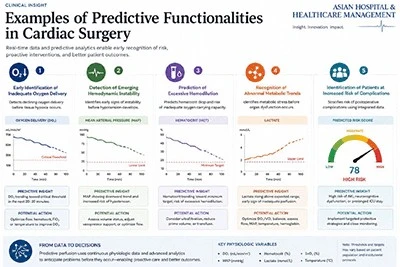
Examples of predictive functionalities include:
• Early identification of inadequate oxygen delivery
• Detection of emerging hemodynamic instability
• Prediction of excessive hemodilution
• Recognition of abnormal metabolic trends
• Identification of patients at increased risk of postoperative complications
By integrating these insights into perioperative workflows, cardiac surgical teams can intervene earlier and more effectively (Figure 1).
Artificial Intelligence and Predictive Analytics
Artificial intelligence (AI) and machine learning technologies are increasingly being explored within cardiovascular medicine and perioperative care. Machine learning algorithms have the capability to analyze large datasets and identify patterns that may not be apparent through conventional statistical methods. In cardiac surgery, these tools can support risk stratification, outcome prediction, and personalized treatment planning.
Potential applications include:
• Predicting acute kidney injury
• Forecasting postoperative complications
• Anticipating transfusion requirements
• Estimating intensive care utilization
• Supporting individualized perfusion strategies
Although many AI-based applications remain under clinical evaluation, early studies suggest significant potential for improving predictive accuracy and supporting evidence-based decision-making. The future of perfusion may involve intelligent systems capable of continuously learning from historical and real-time data to provide increasingly precise recommendations tailored to individual patient characteristics.
Enhancing Patient Safety Through Predictive Monitoring
Patient safety remains the primary objective of all perioperative technologies and clinical innovations. Predictive monitoring contributes to safety by reducing the likelihood of preventable complications and enabling earlier intervention. Instead of relying solely on threshold-based alarms, modern systems can identify subtle physiological trends that precede deterioration. This capability is particularly valuable during complex cardiac procedures where rapid physiological changes can occur. Early recognition allows clinicians to correct developing problems before they progress to clinically significant events. Furthermore, standardized data collection and automated documentation improve transparency, support quality assurance initiatives, and facilitate continuous performance improvement within cardiac surgery programs. The availability of objective data also strengthens multidisciplinary communication among surgeons, anesthesiologists, intensivists, and perfusionists, promoting more coordinated patient care.
Personalized Perfusion Strategies
Not all cardiac surgery patients have identical physiological requirements. Factors such as age, body surface area, comorbidities, preoperative organ function, and procedural complexity influence individual responses to cardiopulmonary bypass. Predictive perfusion supports a transition away from one-size-fits-all approaches toward personalized management strategies. By integrating patient-specific data with predictive models, clinicians can tailor perfusion targets and interventions according to individual risk profiles. This personalization may include optimization of:
• Flow rates
• Oxygen delivery targets
• Hematocrit management
• Temperature strategies
• Hemodynamic goals
• Fluid administration
Personalized perfusion aligns with broader trends in precision medicine, where therapeutic decisions are increasingly guided by patient-specific characteristics rather than generalized protocols.
Challenges to Implementation
Despite its promise, the adoption of predictive perfusion faces several challenges. Data integration remains a significant obstacle, as information is often distributed across multiple devices and platforms that may not communicate seamlessly. Standardization of data formats and interoperability between systems are essential for maximizing the value of digital technologies.mClinical validation is another critical consideration. Predictive algorithms must demonstrate reliability, accuracy, and clinical relevance before widespread implementation. Healthcare organizations must also address issues related to cybersecurity, data governance, and patient privacy.mTraining and education are equally important. Clinicians must develop competencies in data interpretation and digital health technologies to effectively incorporate predictive tools into routine practice. Finally, successful implementation requires cultural change within healthcare organizations, emphasizing evidence-based decision-making and multidisciplinary collaboration.
The Future of Predictive Perfusion
The future of cardiac surgery is likely to be increasingly data-driven. Advances in sensor technology, artificial intelligence, cloud-based analytics, and interoperability will continue expanding the capabilities of predictive perfusion systems. Future operating rooms may utilize integrated digital ecosystems capable of combining physiological monitoring, laboratory data, imaging information, and predictive models into unified decision-support environments. These systems could provide continuous risk assessment and individualized recommendations throughout the perioperative journey. As clinical evidence continues to accumulate, predictive perfusion has the potential to become a standard component of modern cardiac surgery, contributing to improved outcomes, enhanced patient safety, and more efficient healthcare delivery.
Conclusion
Perfusion practice is evolving from a reactive discipline focused on monitoring physiological disturbances toward a predictive model centered on prevention, personalization, and proactive intervention. Through the integration of real-time monitoring, data analytics, clinical decision support systems, and emerging artificial intelligence technologies, cardiac surgery teams can better anticipate risk, optimize oxygen delivery, and improve patient outcomes. While challenges related to implementation, validation, and interoperability remain, the growing adoption of data-driven decision-making represents a significant advancement in perioperative care. Predictive perfusion is not merely a technological innovation; it reflects a broader transformation in how clinicians understand, manage, and optimize patient physiology during cardiac surgery.
References
1 https://pubmed.ncbi.nlm.nih.gov/41767130/
Read the full article — it's free
Register with AmericanHHM to unlock expert insights, research articles and in-depth industry analysis.