Interventional neurology, once considered an aspirational outgrowth of clinical neurology, has evolved over the past three decades into an indispensable component of modern neurovascular care. This dynamic subspecialty bridges the intellectual framework of neurology with the technical precision of catheter-based therapies, offering targeted, often life-saving, interventions for acute ischemic stroke, cerebral aneurysms, arteriovenous malformations (AVMs), venous thromboses, and other complex conditions.
In reviewing the history of interventional neurology, its journey began with the conceptual groundwork laid nearly a century ago. In 1927, Egas Moniz conceived cerebral angiography and essentially created the possibility of visualizing the brain vasculature in vivo. A neurologist by training, Moniz envisioned a world where diseases of the brain could be understood, and eventually treated, through the vessels that supplied it. In all fairness, because of his severe gouty arthritis, he was forced to delegate the task of angiographic procedural completion to his colleague and partner, neurosurgeon Pedro Almeida Lima. As it turns out, Moniz was awarded the 1949 Nobel Prize in Medicine, not for introducing cerebral angiography, but for his work in the application of cerebral leucotomy (lobotomy). However, the decades that followed saw neuroangiographic procedural innovation gravitate away from neurology toward neuroradiology and, to some degree, neurosurgery. In parallel, Moniz’s original vision was being operationalized and morphed into a bona fide interventional discipline.
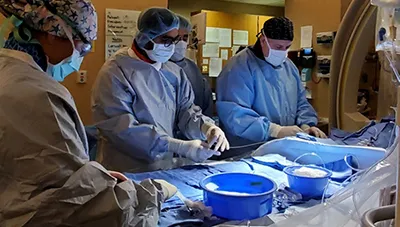
During the latter part of the 20th century, advances in neuroimaging, catheter technology, and clinical emergency systems aligned to bring neurologists back into the procedural arena. In the United States, the 1980s and 1990s saw isolated yet visionary efforts by neurologists who believed they could offer more than observation and diagnosis. Early organized initiatives at Saint Louis University and the University of Alabama at Birmingham led to the development and implementation of operational initiatives such as “Code Stroke” alerts, intended to systematize and operationalize the rapid evaluation and intervention of acute ischemic stroke.
These initial protocols laid the foundation for a neurologist-led procedural model. Initially, due to a lack of a politically acceptable and inclusive neurointerventional infrastructure, partnering with interventional cardiologists, the handful of neurologists directly involved in the incipient subspecialty developed workflows designed to reduce stroke diagnostic and treatment times dramatically. It was in these crucibles of urgent care that neurologists began to reassert procedural credibility, especially as outcomes spoke louder than skepticism. Our own work proved not only that neurologists could perform urgent neuroendovascular rescue but that such a procedural perspective could easily become the anchor point for further procedural development, with progressive amplification of the operators’ interventional skillset.
In parallel, other neurologists around the world were making similar strides and, looking back, the rise of interventional neurology from isolated efforts into a burgeoning movement can be objectively traced and examined. As different programs began to coalesce and subspecialty educational fellowships were introduced, first informally, then through more official pathways via organizations such as the Accreditation Council for Graduate Medical Education (ACGME) and the United Council for Neurologic Subspecialties (UCNS). By 2008, the University of Minnesota had launched the first ACGME-accredited fellowship in “endovascular surgical neuroradiology”, the politically correct name by which the “allinclusive” training programs used to be known.
Interventional neurology today stands on that foundation. It is no longer an experiment. It is a field with defined competencies, a growing body of literature, and a global network of operators. Its practitioners routinely perform not only thrombectomy (i.e., the most common procedure included under the rubric “neuroendovascular rescue”) but also aneurysm coil embolization and flow diversion, liquid and particle embolization for AVM and tumors, angioplasty and stenting of extracranial and intracranial stenotic lesions, treatment of venous sinus thrombosis, endovascular closure of arteriovenous fistulas and, although less frequently, the application of endovascular interventions to the management of spinal disorders.
Unlike many other subspecialists, particularly radiologists, the role of interventional neurologists does not begin at the procedure and end at device deployment. Instead, it resembles the scope of practice of interventional cardiologists, encompassing the full clinical care continuum: initial clinical evaluation, diagnostic imaging interpretation, procedural counseling and planning, catheter-based procedural application, and post-procedure neurocritical management. This level of incorporation brings both intellectual fulfillment and accountability. The ability to integrate clinical signs with imaging patterns and determine the need for intervention constitutes the core skill set of interventional neurologists.
Such a broad scope of practice also underscores the need for structured, high-quality training. Yet herein lies one of the field’s persistent challenges: Training pathways remain heterogeneous. In the U.S., a typical route involves completing a neurology residency followed by fellowships in vascular neurology or neurocritical care, and then a one- or two-year interventional fellowship. However, many training sites remain embedded in neurosurgery or radiology departments, which keep control of access very “close to the vest” and can easily restrict access for neurology-based learners.
In Europe, parts of Asia, and Latin America, the situation varies. In countries such as Colombia and Spain, interventional neurology is often regarded as a “second specialty,” pursued after obtaining board certification in neurology or neurosurgery. These programs may emphasize diagnostic imaging, hands-on catheter skills, and hybrid rotations across specialties. And yet, they too often lack standardized certification mechanisms or formal recognition by regulatory bodies.
Professional societies have played a key role in closing these gaps. The Society of Vascular and Interventional Neurology (SVIN), the Society of Neurointerventional Surgery (SNIS), and the World Federation of Interventional and Therapeutic Neuroradiology (WFITN) all advocate for greater inclusion of neurologists and multidisciplinary training. The SVIN, in particular, has supported early-career development through mentorship, research platforms, and educational initiatives. These efforts are beginning to show results, with an almost exponential growth of the number of interventional neurologists joining the ranks of practicing subspecialists.
On the flip side, the ever-increasing need for interventional neurologists is not hypothetical. Stroke remains a leading cause of death and disability worldwide. The advent of thrombectomy for strokes caused by large (and not-so-large) arterial occlusions has revolutionized the care of these patients, but access to such expert care remains uneven. Many hospitals, particularly in rural or underserved areas, lack adequate interventional neurology coverage. Nevertheless, in geographic locations where interventional neurologists are available, systems of care become more agile, integrated, and responsive to patients’ needs. As a result, outcomes improve, functional recovery rates climb, and the overall quality of neurovascular care is quickly optimized.
Moreover, the impact of interventional neurology extends beyond urgent treatment of ischemic stroke. The elective securement, via coil embolization or flow diversion, of an unruptured aneurysm can prevent a devastating subarachnoid hemorrhage. Timely embolization of an AVM can greatly facilitate surgical removal, which, in turn, can result in better seizure control, reduced risk of hemorrhage, and progressive neurological decline. Treating venous sinus thrombosis with catheter-directed therapy can salvage lives when anticoagulation fails to correct malignant intracranial hypertension quickly. Each of these interventions embodies the field’s ethos: minimally invasive, highly targeted, and informed by neurologic context.
On the other hand, the tools of interventional neurology are only as effective as the clinicians who wield them. That is why the profession must invest in people as much as in educational platforms. Fellowship programs need to be better resourced and hold their graduates to a high standard of critical evaluation. In my personal opinion, interventional neurology is the most complex and challenging field of medical practice currently in existence, and even minimally competent operators do not convey an acceptable level of patient safety and high-quality results.
Conclusion:
In this context, neurology residencies should introduce procedural concepts earlier, while academic departments should promote research and foster collaboration between specialties. Hospitals should recognize that hiring an interventional neurologist is not merely adding a proceduralist; it is acquiring a comprehensively oriented practitioner, one who will seamlessly move between the diagnostic and therapeutic dimensions required for the management of this patient population.
Three decades in, interventional neurology has earned its place not by replacing other disciplines but by complementing them, offering a perspective that bridges diagnosis, intervention, and long-term management. It has moved from being an innovation to becoming an institution. The challenge now is to preserve the pioneering spirit while expanding access, refining systems, and mentoring the next generation.
Interventional neurology is no longer a question of “why” or “if”; it is a discipline of “how” and “what’s next.” It has proven that when neurologists pick up the catheter, they do more than treat vessels; they elevate the neurovascular standard of care.
References
1. Gomez, C. R., & Kern, M. J. (1997). Cerebral catheterization: Back to the future. Journal of Stroke and Cerebrovascular Diseases, 6(5), 308–312. https://doi.org/10.1016/S1052-3057(97)80211-X
2. Qureshi, A. I. (2011). Textbook of Interventional Neurology. Cambridge University Press.
3. Chen, H., Marino, J., Stemer, A. B., Singh, I. P., & Froehler, M. T. (2023). Emerging subspecialties in neurology: Interventional neurology. Neurology, 101(19), e1939–e1942. https://doi.org/10.1212/WNL.0000000000207821
4. Gaspar-Toro, J. M. (2023). Interventional neurology: A growing second specialty. Acta Neurológica Colombiana, 40(2), e1828. https://doi.org/10.22379/anc.v40i2.1828
5. Gomez, C. R. (2024). Ischemic stroke rescue: Future trends in endovascular neurology. Stroke Review, 34(2), 112–119. [If this is a fictional or unpublished source, replace with real journal name or clarify]