
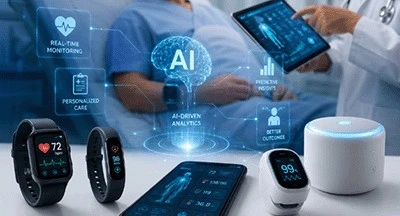
Artificial intelligence is rewriting the rules of medicine. From identifying cancerous lesions in radiology scans to predicting sepsis hours before clinical deterioration, AI's diagnostic and predictive capabilities are no longer speculative; they are increasingly documented in peer-reviewed literature and deployed in real clinical settings. Yet beneath every successful AI model lies a less glamorous truth: the quality of the output is only as good as the quality of the input. For AI to fulfil its promise in managing both acute and chronic disease, it needs continuous, high-fidelity, real-world data. That is precisely where smart devices come in.
A Data Problem at the Heart of Healthcare AI
For decades, clinical decision-making has relied on episodic data; a blood pressure reading at an annual physical, a fasting glucose level drawn in a lab, an ECG captured during a ten-minute cardiology visit. These snapshots are valuable, but they are poor representations of a patient's actual physiological state across the arc of daily life. A person with hypertension may have perfectly controlled blood pressure in the clinic yet experiences dangerous nocturnal spikes at home. A diabetic patient's HbA1c tells a clinician about average glucose over three months but says nothing about the glycemic volatility that independently predicts complications.
AI algorithms trained on episodic clinical data inherit these blind spots. Models built on what happens in hospitals and clinics are not, by default, models of human health, they are models of what health looks like when it is sick enough to seek care. To train and validate AI that can intervene earlier, predict more accurately, and personalise more effectively, we need data from the spaces where patients actually live.
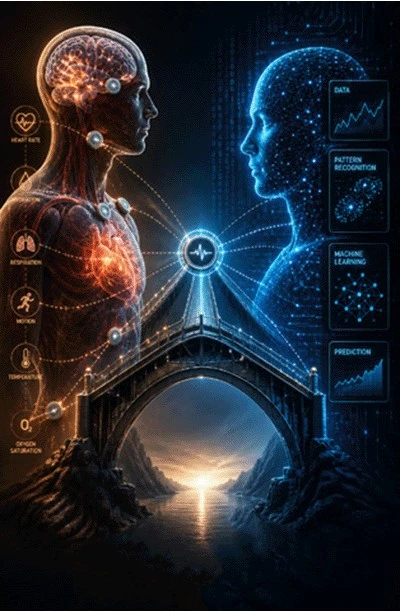
Sensors as the Bridge Between Biology and Algorithm
Smart devices: Wearables, implantables, ambient home sensors, and connected diagnostic tools, are filling that gap by embedding measurement capabilities into the fabric of everyday life. A modern consumer smartwatch can continuously monitor heart rate, detect atrial fibrillation, estimate blood oxygen saturation, and track sleep architecture, all without a single clinical encounter. Continuous glucose monitors worn on the upper arm relay interstitial glucose readings every few minutes, generating thousands of data points per week from a patient who might otherwise see their endocrinologist twice a year.
The physiological signals these devices capture span an expanding range. Accelerometers detect gait abnormalities that may signal early Parkinson's disease or fall risk in the elderly. Skin-mounted electrodes record electrodermal activity as a proxy for autonomic nervous system function, with implications for stress, anxiety, and pain management. Implantable cardiac monitors sit subcutaneously for up to three years, providing long-term arrhythmia surveillance that no Holter monitor worn for 48 hours could replicate. Ingestible sensors embedded in medication capsules can confirm that a pill has been swallowed and absorbed; critical data in conditions where non-adherence is a primary driver of poor outcomes.
Each of these streams, taken individually, is interesting. Fed collectively into well-designed AI systems, they become transformative.
From Raw Signal to Clinical Intelligence
The power of smart devices is not in the data collection alone; it is in what AI does with that data at scale. Machine learning models, and particularly deep learning architectures, are well-suited to finding patterns in high-dimensional, time-series physiological data that no human clinician could detect by inspection. An AI model trained on millions of continuous glucose monitoring traces can learn to recognise the subtle signatures that precede a hypoglycemic event hours in advance, alerting the patient or their care team before a crisis occurs. A model trained on continuous cardiac data from thousands of patients can identify the early electrical perturbations that predict sudden cardiac death in a population previously deemed low risk.
Personalisation is another dimension where this pairing shows particular promise. Traditional clinical guidelines reflect what works on average for a population, but medicine is practised on individuals. With continuous longitudinal data, AI systems can build dynamic models of a specific patient's baseline and flag meaningful deviations from it. A resting heart rate that is unremarkable for one person may signal incipient illness in another. This shift from population-based to individual-based clinical reasoning is one of the most significant potential advances in medicine in a generation, and continuous device data is what makes it computationally feasible.
Chronic Disease Management: The Immediate Opportunity
The burden of chronic diseases such as cardiovascular disease, diabetes, heart failure, and chronic kidney disease accounts for the vast majority of healthcare expenditure in high-income countries and a rapidly growing share elsewhere. These conditions require sustained monitoring and timely treatment adjustment across years and decades, and they are among the conditions most amenable to smart device-enabled, AI-driven management.
In heart failure, for example, implantable pulmonary artery pressure sensors can detect hemodynamic congestion days before clinical decompensation, enabling pre-emptive diuretic adjustments that reduce hospitalisations. In asthma, smart inhalers equipped with flow sensors and GPS logging can identify environmental triggers and patterns of poor technique or under-use of preventer therapy, feeding AI models that adapt coaching interventions to the individual patient's behavior and context. In chronic kidney disease, at-home urinalysis strips connected to smartphone apps can track proteinuria trends over time, helping AI systems flag trajectories that warrant nephrology review before irreversible progression occurs.
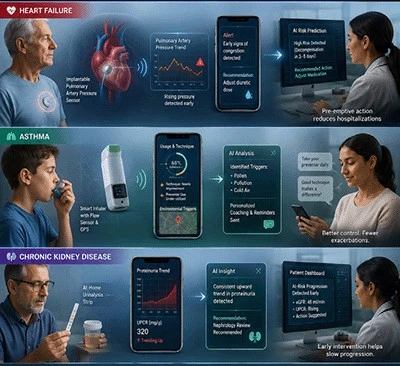
The common thread in each of these applications is the compression of the feedback loop between physiological change and clinical response. Chronic disease management has historically operated on timescales of weeks and months. Smart device-AI integration can compress that to days and hours.
Acute Illness and Early Warning
The opportunity is not limited to chronic conditions. In acute illness, early detection is often the difference between a manageable intervention and a catastrophic outcome. AI systems trained on continuous vital sign data can identify early signatures of deterioration like rising respiratory rate, declining heart rate variability, subtle changes in temperature or activity and then trigger clinical escalation before emergency presentation becomes necessary. During the COVID-19 pandemic, studies using consumer wearable data showed that elevated resting heart rate and altered heart rate variability preceded self-reported illness by several days, suggesting that continuous monitoring could support both individual early warning and population-level syndromic surveillance.
Reimagining Traditional Medical Devices as Data Sources
Beyond consumer wearables and purpose-built monitoring tools, one of the most consequential and underappreciated frontiers in smart healthcare is the transformation of traditional therapeutic medical devices into active data-generating platforms. Implants, catheters, prosthetics, and other hardware that have long served purely mechanical or pharmacological functions are now being outfitted with embedded sensors and wireless transmission capabilities, turning passive instruments into continuous conduits of physiological intelligence.
Orthopedic implants offer a compelling example. Smart knee and hip replacements embedded with pressure and strain sensors can transmit load data in real time, allowing AI systems to monitor gait mechanics, detect early signs of implant loosening or wear, and flag biomechanical deviations that predict revision surgery months or years before clinical symptoms emerge. This shifts orthopedic follow-up from a calendar-driven model, a clinic visit at six weeks, six months, or one year, to a continuous surveillance model driven by actual device performance.
In cardiology, next-generation pacemakers and implantable cardioverter-defibrillators already transmit daily diagnostic summaries via wireless home monitors, but newer platforms go further. Smart cardiac resynchronisation devices can sense intrathoracic impedance as a surrogate for fluid accumulation, providing early warning of impending heart failure decompensation alongside their primary pacing and defibrillation functions. AI models analysing the continuous data streams from these devices can detect subtle trends; gradual shifts in impedance, changes in activity levels, altered heart rate variability and then generate actionable alerts days before the patient becomes symptomatic.
Intravascular and intracranial devices are following a similar trajectory. Smart cerebral shunts used to manage hydrocephalus are being developed with integrated pressure sensors that wirelessly relay intracranial pressure readings, replacing the current standard of care, which often involves symptomatic assessment and invasive measurement, with continuous, non-invasive surveillance. In nephrology, tunneled dialysis catheters equipped with flow and pressure sensors can monitor access function in real time, enabling AI systems to predict catheter dysfunction and schedule timely interventions before access failure forces emergency management.
Drug-eluting and drug-delivery implants represent another dimension of this convergence. Smart insulin pumps already close the loop with continuous glucose monitors to form hybrid artificial pancreas systems, but the principle extends broadly. Implantable intrathecal drug delivery systems for chronic pain or spasticity management are being paired with biosensors that monitor therapeutic targets like cerebrospinal fluid biomarkers, local tissue pH, and patient-reported pain scores transmitted via companion apps, allowing AI systems to optimise dosing regimens dynamically rather than relying on static programming adjusted at infrequent clinic visits.
What unites these applications is a fundamental reframing of the purpose of a medical device. Traditionally, the purpose of an implant or catheter ends at its mechanical or pharmacological function; it stabilises a joint, maintains a cardiac rhythm, delivers a drug. In the smart device paradigm, the therapeutic function becomes one component of a broader system in which the device is simultaneously a treatment platform and a sensor array. Every interaction between device and biology becomes a data point, and the aggregate becomes raw material for AI-driven clinical intelligence; one that can reduce unnecessary revision surgeries, catch malfunctions earlier, and direct clinical attention toward patients whose telemetry indicates genuine deterioration rather than normal variation.
The Challenges
None of this comes without significant challenges. Data privacy and security are paramount concerns: the continuous physiological surveillance enabled by smart devices generates intimate, sensitive health information that requires robust protection and clear governance frameworks. Patients must have genuine agency over who accesses their data and for what purposes, and the commercial incentives of device manufacturers and technology platforms must be transparently managed to prevent exploitation.
Signal quality and clinical validation represent a second layer of concern. Consumer-grade wearables carry variable accuracy; heart rate estimation degrades with motion artifact, and optical SpO2 readings have documented limitations in individuals with darker skin tones, a disparity that AI systems trained on non-representative datasets will amplify rather than correct. Algorithmic fairness is therefore inseparable from device quality. For example, if the data feeding AI systems comes predominantly from wealthier, more technologically engaged populations, the resulting models will perform unevenly across the broader patient population, making representative data collection and inclusive model development not optional extras, but core requirements.
The Path Forward
The convergence of ubiquitous sensing, connectivity, and machine learning is opening a new chapter in healthcare, one defined not by the episodic encounter but by continuous, personalised, data-informed care. Smart devices are the essential infrastructure for this transition, providing real-world physiological data that AI algorithms need to move from research curiosity to clinical utility.
Realising this potential will require sustained collaboration across medical institutions, technology developers, regulators, and patients themselves. It will require investment in data standards and interoperability so that signals from different devices and platforms can be meaningfully aggregated. It will require regulatory frameworks that evolve to evaluate AI-device combinations as integrated clinical systems rather than isolated components.
AI alone already represents a major leap forward in medicine, capable of synthesising millions of clinical studies and decades of accumulated medical knowledge in ways no human researcher could match. But its true transformative power emerges when paired with smart sensors generating real-time physiological data from millions of patients worldwide, across every culture, ethnicity, gender, age, and socio-economic background. This fusion doesn't just add to our understanding of physiology and medical practice; it expands it, revealing patterns and insights that neither AI nor sensor data could surface alone.
References
1. Vesco-Mura et al. "Wearable Devices to Diagnose and Monitor the Progression of COVID-19 Through Heart Rate Variability Measurement: Systematic Review and Meta-Analysis." J Med Internet Res, 2023. Found that wearable HRV measurements were associated with COVID-19 onset and worsening, in some cases predicting onset before a positive clinical test. https://www.jmir.org/2023/1/e47112
2. Mishra T, et al. "Pre-symptomatic detection of COVID-19 from smartwatch data" (Stanford/Mount Sinai studies, reported via CBS News). Smartwatches measuring heart rate, skin temperature and other physiological markers can help identify coronavirus infections days before diagnosis. https://www.cbsnews.com/news/covid-symptoms-smart-watch/
3. Hirten RP, et al. "Use of Physiological Data From a Wearable Device to Identify SARS-CoV-2 Infection and Symptoms and Predict COVID-19 Diagnosis" (Warrior Watch Study), J Med Internet Res, 2021. Heart rate variability metrics from a commercial wearable predicted COVID-19 diagnosis and identified related symptoms; the Mount Sinai summary notes HRV changes signaled COVID-19 onset up to seven days before nasal-swab diagnosis. https://pmc.ncbi.nlm.nih.gov/articles/PMC7901594/ and https://www.mountsinai.org/about/newsroom/2021/mount-sinai-study-finds-wearable-devices-can-detect-covid19-symptoms-and-predict-diagnosis-pr
4. Abraham WT, et al. CHAMPION Trial. Pulmonary artery pressure-guided heart failure management using the CardioMEMS sensor reduced HF hospitalizations by 28% at six months, sustained at 37% over the full study duration. https://cdn.clinicaltrials.gov/large-docs/91/NCT02693691/Prot_SAP_ICF_000.pdf
5. Shavelle DM, et al. "Lower Rates of Heart Failure and All-Cause Hospitalizations During Pulmonary Artery Pressure-Guided Therapy... CardioMEMS Post-Approval Study." Circ Heart Fail, 2020. In a 1,200-patient multicenter study, HF hospitalization rates dropped from 1.25 to 0.54 events/patient-year after sensor implantation, with high freedom from device complications and sensor failure. https://pubmed.ncbi.nlm.nih.gov/32757642/
6. Sjoding MW, et al. "Racial Bias in Pulse Oximetry Measurement" and related meta-analysis: A meta-analysis of 32 studies found pulse oximetry overestimates oxygen saturation in people with high skin pigmentation (pooled bias 1.11%) and in those described as Black/African American (1.52%), with Black patients having nearly three times the rate of undetected occult hypoxemia compared to White patients. https://www.ncbi.nlm.nih.gov/pmc/articles/PMC9377806/
7. Feiner JR, Severinghaus JW, Bickler PE. "Pulse oximetry, racial bias and statistical bias." Early studies from the 1990s already reported pulse oximetry was substantially less accurate in Black patients, attributable to skin pigmentation affecting light absorbance at the measurement wavelengths. https://www.ncbi.nlm.nih.gov/pmc/articles/PMC8723900/
Read the full article — it's free
Register with AmericanHHM to unlock expert insights, research articles and in-depth industry analysis.