
Here, we discuss how AI/ML and the inroads into structural biology and drug design can be harnessed to one-up infectious diseases, autoimmune pathologies and inherited syndromes?
As aforementioned, the relatively recent health-related outbreak exacted a tremendous societal toll. SARS-CoV-2 ranks amongst the most lethal viruses in human history alongside H1N1, Variola (smallpox), Yellow fever Virus Marburg, Ebola, and Hanta. Nevertheless, this pandemic also brought out the best in humankind. Be it the humanitarian efforts of nurses, doctors, allied health care workers, emergency care personnel, hospital janitors, police, social workers, emergency services workers who collectively were the first responders, the call for responsible conduct by scientific, social, political luminaries across the globe, the embrace of “Zoom” as a medium for seminars, meetings, music events, and the like, or the efforts of scientists whose worked behind the scenes to eventually revolutionize the way we think about drug-discovery and invention, there was a collective role at play; no component was redundant. Every face and facet and modicum of intervention and prevention mattered.
So profound was the impact of this pandemic that the equally Herculean task to thwart its spread garnered the 2023 Nobel Prize in physiology or medicine within a year or two after path- breaking efforts of the prize winners had been put into application. The citation from Sweden simply stated: The Nobel Prize in Physiology or Medicine 2023 is awarded jointly to Katalin
Karikó and Drew Weissman "for their discoveries concerning nucleoside base modifications that enabled the development of effective mRNA vaccines against COVID-19". Yet, for those who paid the ultimate price, and particularly relatives those of, it is a poor consolation and one that came too late.
One particular interaction leading to infection
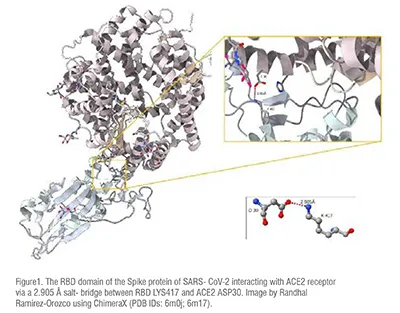
Let me start by paraphrasing one of the host-guest interactions leveraged by SARS-CoV-2 to invade human host cells: The coronavirus spike protein hijacks ACE2, an enzyme that processes a peptide hormone that controls blood pressure called angiotensin. The process of viral entry is initiated by the binding of the spike protein receptor binding domain (RBD) to ACE2. To cement the biological docking of the virus onto the human host, the virus spike protein RBD residue LYS417 forms a salt-bridge with ASP30 of ACE2, spanning a mere 2.9 Å of micro-cosmic spatial emptiness. To put it somewhat bluntly, the rest is 7M+ lives of costly history.
Attempts to one-up the virion spurred unforeseen efforts. One such tactic was the introduction of a neutralizing antibody fragment (Fab) that compromises the aforementioned atomic-scale interaction between the Lewis acid and the Lewis base and qualifies as an “antiviral” or vaccine. (Figure 01)
Ironically, 2020 seems far removed already and it is true that tremendous strides have since been made by structural biologists, computational biologists, biophysicists, medicinal chemists, geneticists, genomicists, drug-discovery gurus, and the pharma industry in pre-empting future outbreaks. The modus operandi has been through impromptu, designed and repurposed developments in vaccine production, small-molecule anti-virals, immunomodulators including glucocorticoids such as dexamethasone, cytokine antagonists such as tocilizumab and Janus kinase inhibitors such as baricitinib.
Nevertheless, it is said that those who don’t learn from history are bound to repeat it. Therefore, it is an opportune time for us to take a step back, view the biomedicopharma canvas and do a “SWOT” analysis. In fact, it simply behooves us to do so.
Future Preparedness
It is important to recognize the proclivity of SARS-CoV-2 to “acclimatize” to treatment regimens via mutaevasion, due to the receding geopolitical boundaries, anthropogenic factors such as nuclear waste stockpiles, or global warming which makes for a hospitable environment. The socio-political climate which frequently energizes the “anti-vaxxers”, the introduction of wild an exotic game for human sustenance or for domestic entertainment, post-COVID spurs in tourism, etc also almost ensure that the likelihood of the next pandemic is around a corner near you.
The existence of these multifactorial causals demands that we remain at least one step ahead of any future attack by applying avante garde tools and techniques in the biomedical arena that can pre-empt a Covid-like spread and thwart the loss of health and life. It is here that the tested adage that only the fittest survive and evolution is a product of random mutation can be leveraged in combination with the recent advents in predictive and AI-assisted technologies to potentially prepare the human race against future virion threats. For example, the last 5 years have witnessed unprecedented maturation of the tools used in the areas of structural biology, computational biology and drug discovery. Advances in Cryo-EM have resulted in sub-angstrom resolution of magnum complexes which, in many cases, have made redundant traditional techniques such as X- ray and NMR. AI/ML and predictive structural biology tools such as AlphaFold and ESMFold have further marginalized the aforementioned classical experimental approaches. The first principles of genetics combined with the state-of-the-art advances in technology potentially are the current antidotes and anti-virals when properly leveraged. This is elaborated below.
Advances in Predictive Biology
Perhaps the greatest strides in the last couple of years have been made in the area of structural biology The 2024 Chemistry Novel was in part awarded to David Baker of the University of Washington and to Demis Hassabis and John Jumper of Google DeepMind for “protein structure prediction”. The Nobel committee states (https://www.nobelprize.org/prizes/chemistry/2024/press-release/):
One of the discoveries being recognized this year concerns the construction of spectacular proteins. The other is about fulfilling a 50-year-old dream: predicting protein structures from their amino acid sequences. Both of these discoveries open up vast possibilities,” says Heiner Linke, Chair of the Nobel Committee for Chemistry.
In 2020, Demis Hassabis and John Jumper presented an AI model called AlphaFold2. With its help, they have been able to predict the structure of virtually all the 200 million proteins that researchers have identified. Since their breakthrough, AlphaFold2 has been used by more than two million people from 190 countries. Among a myriad of scientific applications, researchers can now better understand antibiotic resistance and create images of enzymes that can decompose plastic.
Life could not exist without proteins. That we can now predict protein structures and design our own proteins confers the greatest benefit to humankind.
Matching the aforementioned strides made in experimental and computational structural biology are developments in the platforms used to render newly available and previously existing structures. User-friendly platforms such as ChimeraX and Blender are able to help users interface with structures rapidly, with high-resolution and across myriad parameters such as bond angles, bond distances, textures, dynamics, etc.
Paralleling the structural revolution is the renaissance across the drug-discovery canvas. The last two years have resulted in a spate of inroads into synthesis, the screening of large chemical spaces, predictive toxicology and molecular activity, the ability to reduce off-target outcomes, tailoring of properties, and personalized therapies. AI/ML has been front and center in enabling many of these advances. The last 10 years have seen therapeutic strategies embrace the biologics’ space. A departure from small molecule-based disease-resolving frameworks to vaccines, growth factors, immune modulators, monoclonal antibodies, gene therapies, transplant tissue, stem cell therapies, and recombinant proteins has become the norm. Nevertheless, it is like that the ability of AI/ML to far outpace brute force methods which include biologics development would suggest that small-molecules, even if repurposed, may be back in vogue.
A Primer into mRNA based Vaccines
Vaccines help “inoculate” the body from non-self attacks such as from viruses, bacteria an (in the future) fungii. Traditionally, vaccines are inactive forms of the pathogen which act as “priming” antigens to invoke an immune response from the body to develop antibodies. These antibodies are capable of engulfing the “true” (virulent) pathogen and preventing the spread of infection. By contrast, the development of mRNA based vaccines is a paradigm shifting departure from the norm. The mRNA codes for a protein which cells use to synthesize. The mRNA is rapidly broken down and does not interfere with the native genetics of the cell that it is introduced into.
The protein that the introduced mRNA codes for corresponds to a protein found in the virus that is of interest. The choice of protein is generally from among those that might be responsible for its entry into the host cell such as those found on the coat. However, this is not absolutely necessary and a protein within the virus can also be adopted to develop the vaccine. The host cell uses the host machinery to produce the viral protein which is recognized by the host immune response as being “foreign”. The process of antibody development then begins against the viral protein and against the actual viral attack. These antibodies once produced, linger in the body long after the pathogen has been destroyed. This primes the immune system for further attacks.
Essentially, severe illness and death can be averted. In the US vaccines for COVID-19 are the only authorized or approved mRNA vaccines.
The COVID-19 mRNA vaccines were designed to produce the spike protein which, as aforementioned, binds ACE2 via its receptor binding domain (RBD).
Turnkey Designer Vaccines
We can now revisit the interaction between the Spike protein and ACE2 that resulted in COVID-19 and examine how we can potentially be better prepared for any future outbreaks.
Viruses including SARS-CoV-2, like any other organism, mutate. However, nature ensures the survival of the fittest. Thus, mutations that further stabilize interactions between the Spikes
Protein RBD domain and ACE2 can be thought to be selected for versus those mutations that may be less infections. At the atomic and molecular level, mutations that result in the conversion of RBD LYS417 to ARG417 are likely to further stabilize the salt-bridge with ASP30. This is because the difference of the additional guanidinium linkage in the longer ARG its likely to decrease the length of the salt-bridge from 2.9 Å to a potentially more favorable value. Furthermore, the pKA of an ARG side-chain is more basic than that of a LYS, which potentially results in a stronger salt bridge between the hypothetical mutant RBD ARG417 amino group and the corresponding carboxylate of the ACE2 (Figure 02)
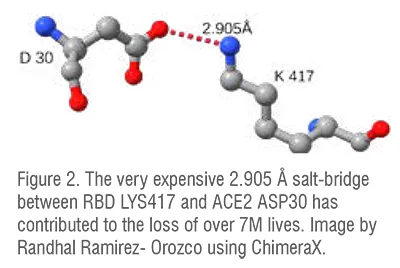
ASP30 with all other constraints such as bond-angle, charge density, steric differences remaining constant.
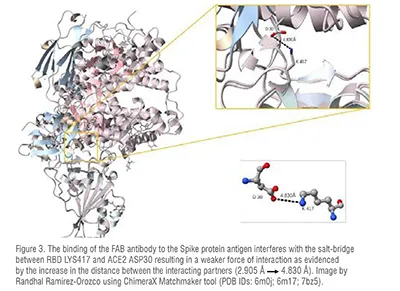
One of the initial neutralizing antibodies created against the RBD perturbed the interactions between LYS417 (of the RBD) and ASP30 (of the ACE2) by increasing the distance of the salt-bridge beyond the stabilizing limits in the antibody: RBD complex (2.905 Å -> 4.830 Å). This prevented the docking and entry of the spike protein onto the ACE2 and host cells. The highly antigenic nature of the spike protein, via its RBD, is essentially “neutralized” (vaccinated against).
Such a stratagem may only be partially effective in case of a mutant
LYS417ARG SARS-CoV-2 strain. This is because the increased free energy of the salt-bridge between the RBD ARG417 and ASP30 may be sufficient to overcome the previously sufficient interfering enthalpic interactions between the antibody (vaccine) and the original antigen (RBD LYS417)).
Today however, using the predictive tools of AI/ML, Alphafold, DeepMind, it is possible to rapidly generate a suite of mutant RBD structures, including LYS417ARG and beyond, that are more stable than the initial, or even current, SARS-COV2 variants. Furthermore, the energetic interactions between such mutant RBDs and the ACE2 can easily be computed and ranked.
Multiple-mutations such as the N501Y in the Omicron (and Alpha, Beta, and Gamma variants) which increases the binding strength of the spike protein with ACE2 coupled with the T478K, S477N, Q496S, Q493R, and Q498R thought to increase the interaction between the Omicron variant and human ACE2 can be predicted. Strains containing these mutations are likely to prevail over the original SARS COV-2 strain (survival of the fittest). mRNA that code for these strains can be generated and a turnkey approach to vaccination created.
The turnkey designer vaccine strategy can be generalized to include pox, RSV, influenza, oropouche among others.
It is a strategy that combines the current know-how enabled by structural biology with futuristic targets which still don’t exist- one enabled by predictive biology.
Predictive Pharmacotherapy
The human lifespan and quality of human health are limited by errors in our machinery and by external events including disease. Other than hereditary, the some of the categories of diseases affecting humans are infectious (viral, fungal, bacterial, parasitic), autoimmune, neurogenerative, chemical imbalance (neurological).
Can we apply the principles from COVID-19 to these malaises? Can we engender the advances in structural biology, computational biology, AI/ML and its contributions to drug discovery to effectively both prevent and cure outcomes associated with health afflictions?
This author is confident that we are, in principle, uniquely enabled to one-up future epidemics. The only question is whether the policies, political and economic will power exists to create a shelf-full of mRNA’s that code for every unique variant of every known virus let alone chronic and acute maladies. Perhaps I will discuss this in a future piece?