
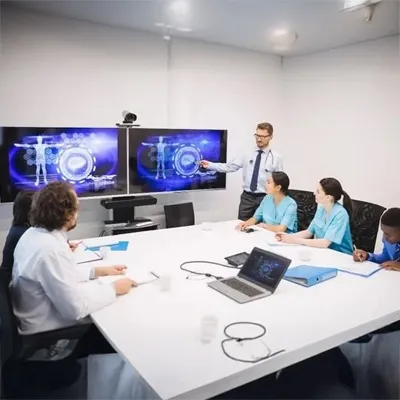
A rapidly evolving healthcare world can no longer afford to be constrained to operational control and regulatory conformity by the hospital administrators. They are also making strategic leaders and they are now applying technology, innovation, and data-driven decision-making to revolutionize future healthcare delivery. Not only should the future hospital administrator be conversant with the complexities of patient care, but he or she must be able to balance organizational vision, digital transformation, workforce management, financial sustainability and strategic expansion. The technology-strategy convergence is transforming healthcare administration leadership, and it is regarded as one of the most transforming and influential fields of the 21st century.
The Shifting Role of Hospital Administrators
Conventionally, hospital administrators were considered as managers who made sure that facilities operate efficiently - balancing their budgets, departments and compliance with the government regulations. Although these functions are still relevant, the modern environment requires quite a lot more. Hospitals are going through the most challenging times in their history: mounting patient demands, need to cut expenses, accelerating technological changes, increasing competition, and mounting calls of transparency.
In this regard, hospital administrators should play several roles: a strategist, technologist, policy specialist, financial planner, and a change leader. Their responsibility has grown beyond the need to guarantee the efficiency of operations to the need to lead innovation, development of patient-centered models of operation, and targeted sustainable growth. The difference between the next generation and the previous one is that the former can combine the old leadership process with progressive and forward-thinking attitude based on digital literacy and adaptability.
Technology as the Core Enabler
Technology integration in the healthcare sector is not an additive that is expected to be integrated--it has to be there. Next-gen administrators should be knowledgeable about leveraging the strength of digital resources to bring increased patient outcomes, operational efficiency, and streamlining processes.
Electronic health records (EHR) and artificial intelligence (AI) as well as telehealth and robotics are not a distinct functionality anymore, but rather a part of the health care delivery fabric.
Data-Driven Decision Making:
The data produced in hospitals is huge. Administrators should be able to work out on how to convert this information into actionable information. Leaders can know what the patients want and what the staff need, and utilize resources in the best way possible through fast business intelligence, machine learning, and predictive analytics. Using real-time information, decision-makers can develop robust and flexible systems of health care.
Telemedicine and Remote Care:
Telehealth adoption was boosted by the COVID-19 pandemic, but its worth is much broader than the management of crises. Telemedicine is broadening access to underserved populations, decreasing hospital congestion, and enhancing convenience to patients. The future administrators need to develop sustainable telehealth plans, compliance, reimbursement models, and assimilations of in-person care.
Automation and AI:
Diagnostic, treatment planning, and administrative efficiency are being transformed by AI-driven tools. Billing, claims and scheduling can be automated using robotic process automation (RPA) to free employees to attend to patients. Administrators of the hospital should be highly critical of these tools, and weigh the cost-effectiveness with the ethical issues and staff flexibility.
Cybersecurity:
Hospitals are susceptible to cyber threats as they get digitalized. The following generation of administrators should focus on cybersecurity policies and establish a balance between the availability of patient data and privacy of sensitive information. Making digital systems trustworthy will be as vital as providing medical excellence.
Strategic Leadership in a Complex Landscape
Technology does not alter healthcare by itself. Effective administration of a hospital has always been anchored by strategy. Administrators have the role to create long term road maps that would balance both innovation and financial accountability so that the hospitals can keep up with the competition yet deliver services to their communities in an exemplary manner.
Financial Stewardship:
The increasing healthcare delivery cost is a challenging one. Administrators should reconsider the management of costs in the form of value-based care models, minimize unnecessary costs, and maximize operational efficiency without sacrificing quality.
Next-gen leaders know that financial health is not by alone reducing its costs but by investing in technology, training and infrastructure in a strategic manner.
Patient-Centric Care Models:
Modern patients prefer more than medical care; he/she desires transparency, individualization and a holistic experience. Administrators need to build systems that make more efforts on patient engagement - be it digital health systems, preferred care paths, or feedback. The hospitals of the future will be assessed more on patient satisfaction as compared to clinical outcomes.
Talent and Workforce Management:
The workforce is as good as a hospital. Burnout and staffing shortages represent serious threats, so administrators need to work out new workforce policies. Predictive staffing with the help of AI, the creation of continuous training opportunities, and the promotion of a healthy culture are no longer fringe benefits but the key to hospital sustainability. The leaders of the new generation will need to find a balance between technological automation and humanity that will be the hallmark of healthcare.
Collaborative Ecosystems:
None of the hospitals can flourish in isolation. Administrators have to establish contacts with technology partners, pharmaceutical companies, insurers, and even startups. The strategic collaborations can assist hospitals to gain access to the state-of-the-art innovations and build the synergies along the healthcare value chain. Ecosystem thinking will make leaders place their hospitals in a long-term resilient and growing position.
The Strategic Use of Innovation
Hospital administration innovation goes beyond technology- it includes redesigning process, new business model, and anticipating future disruption. Those administrators who adopt the innovation concept as one of its principles will spearhead institutions that are responsive and flexible.
As an example, value-based care is shifting the emphasis on volume to outcomes and promoting the alignment of financial incentives with quality measures by hospitals. Administrators have to steer their organizations through this change and make sure that clinicians are involved and systems coordinated in a way that outcomes can be measured.
On the same note, implementation of precision medicine and genomics in healthcare demands administrators to reconsider data management and insurance policies and communication with patients. These innovations require not only technologically literate but also strategy-wise foresight leaders.
Leadership Qualities of Next-Gen Administrators
The unique combination of the leadership features with which the new generation of hospital administrators will have to develop to succeed in such an environment will be necessary. There is need of strategic vision, digital fluency, flexibility and teamwork thinking. In contrast to the past generation, administrators who work nowadays have to be ready to operate in the ambiguous environment, lead varied teams, and guide the change on a large scale.
They should also learn to use emotional intelligence to relate with their staff and patients so that human empathy is not pushed to the periphery of a highly digital healthcare system. It will be the role of future leaders to juggle between efficiency and compassion.
Global Perspective and Policy Alignment
The hospital administrators work in a globalized world where the policies, regulations, and expectations of the patients are interrelated. Leaders have to be briefed up on the international best practices, regulatory change, and global health priorities. An alignment of the hospital strategies, with the national healthcare policy and global frameworks, including sustainability and equity in healthcare, will become a more significant issue.
The emphasis on sustainability, including, is that administrators need to decrease the carbon footprints of their hospitals, implement eco-friendly measures, and shape operations to meet larger environmental objectives. Progressive management recognizes that it is not merely a moral duty, but also a competitive advantage, in the age of conscious consumerism, to be sustainable.
The Road Ahead: Balancing Tradition and Transformation
The future of hospital management is in finding a balance between maintaining the nature of healthcare and innovativeness. Technology will keep increasing the pace of change, and administrators should not make sure that hospitals become sterile facilities that run only on algorithms. Human connection, empathy, and trust are the pillars of healthcare, and a leader needs to build a system that enhances, not eliminates these values with technology.
The next generation administrators will have the responsibility of constructing facilities that are nimble, patient-centered, financially robust, and technologically superior. Knowing what is going to happen tomorrow - whether it is AI, biotechnology, or the next world war - will put extraordinary leaders ahead of ordinary ones. Ethical responsibility, along with the strategic foresight, will make the future of hospital administration.
Conclusion
Hospital administrators have never had a more critical--or more complicated role. Since healthcare is where technology, strategy, and human need meet, the following generation of administrators will determine how hospitals will develop over the next several decades. They should combine digital change and financial custodianship, balance between innovation and empathy and be able to command firms that are as responsive as they are caring.
The role of hospital administrators in this new terrain is not merely as a facility manager but as the architect of tomorrow of healthcare. They are capable of leading technology and strategy and that will not just make their institutions successful but the quality of care the patients get globally. The hospitals of the future will be constructed by leaders that have realized that the future of the healthcare industry does not lie in either opting to use technology over humanity or vice versa but in ensuring that both are balanced to provide better, smarter and more caring care.