
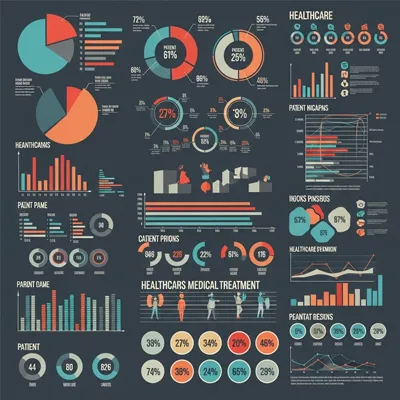
Healthcare economics deals with the examination of the allocation of scarce resources in healthcare systems to enhance health benefits. Healthcare is complicated, unlike a traditional market, since it entails life and death decisions, perception of value, and those concerned with it are many; the patients, health providers, medical insurance companies, and governments.
The most important question in healthcare economics is: How do we do the best possible with the available resources in terms of health?
This question leads to the consideration of two major concepts: cost and value. Cost is the resources that are used to provide healthcare, whereas value is the health that is gained in comparison with the expenditures. The knowledge of these concepts enables the stakeholders to assess the value of investing in the healthcare interventions.
The Concept of Cost in Healthcare
1. Direct Costs
Direct costs are the costs that are directly related to medical care. They are hospital admission, doctor visit, medication and testing, and surgery. Illustratively, the price of a knee replacement would cover the surgeon's fee, hospital bill, prosthetic components, as well as rehabilitation after the operation.
2. Indirect Costs
The less apparent but equally important costs are indirect. They consist of lost productivity because of sickness, the cost of absenteeism in the quest to take care of the sick, or permanent disability expenses. In the case of chronic illnesses such as diabetes or cardiovascular diseases, indirect costs may be more than direct medical costs in the long run.
3. Intangible Costs
Intangible costs are the effects on quality of life - suffering, pain, emotional stress, or decreased social activity. Although they may not always be defined in a monetary context, they have a reflection on the total economic burden of disease.
4. Opportunity Costs
The opportunity cost is perhaps the most crucial concept in economics, and this is the benefits that are forgone when resources are utilized in one direction rather than another. As an illustration, a government that spends a lot on advanced cancer treatment may not be able to spend a lot on preventive care programs.
The Concept of Value in Healthcare
The cost measures are expenditure, whereas the value measures are benefits. Value has been defined as:
Value = Health outcomes achieved / Cost of achieving those outcomes
This equation is important in that more expenditure does not imply more value. An example is when a generic drug is made cheaply and effectively as a branded drug, giving a better value.
1. Clinical Value
This is with regard to patient outcome improvements- lower mortality, fewer complications, or better quality of life.
2. Economic Value
Cost saving based on benefits is an economic value measure. As an illustration, vaccinations are cost-effective since these vaccines help to avoid costly hospitalizations.
3. Societal Value
The societal value does not focus on individual consequences but looks at the benefits to the communities. Smoking cessation programs are public health interventions that not only benefit the individual but also society as a whole, through cost reduction in healthcare and enhancement of productivity.
The Relationship between Cost and Value
There is always a conflict between cost and value in healthcare systems. The increase in the cost of healthcare is seen as a subject of debate on whether the rewards are worth the risks. To take a case in point, a cancer drug that extends life and costs thousands of dollars monthly will present issues of cost and fairness.
Economic evaluations help policymakers, insurers, and providers to analyze this equilibrium. These include:
• Cost-effectiveness analysis (CEA): The costs and the outcomes of two or more interventions are contrasted.
• Cost-utility analysis (CUA): The Matrix is calculated as several quality-adjusted life years (QALYs).
• Cost-benefit analysis (CBA): Transform both costs and benefits into financial terms to compare them.
These tools can be used to ensure that scarce resources are used in interventions that generate maximum value.
Drivers of Healthcare Costs
1. Technological Advancements
New technologies improve care, but so does it raise costs. Robotic surgeries, gene therapies, and advanced imaging machinery can turn out to be expensive to install and maintain.
2. Aging Population
With aging populations, there is a rise in chronic disease prevalence, resulting in a rise in health care utilization and expenditure.
3. Administrative Costs
In nations where insurance is complicated, administrative expenses such as billing, claims processing, and legal compliance may raise the total expenses substantially.
4. Lifestyle Factors
Unhealthy lifestyles, such as obesity, smoking, and sedentary living, cause expensive chronic illnesses such as diabetes and heart disease.
5. Pharmaceutical Pricing
One of the biggest contributors to healthcare costs is the pricing of drugs. The problem is also worsened by the high costs of specialty drugs and unregulated markets in certain states.
Measuring Value in Healthcare
In order to quantify the value, the healthcare systems have resorted to measurement indicators that are both quality- and efficiency-based.
1. Outcomes-Based Metrics
Such measures as survival rates, readmission rates, infection rates, and patient-reported outcomes are all of clinical value.
2. Quality-Adjusted Life Years (QALYs)
QALYs are measures of the length and quality of life that are used together. They are very common in the cost-utility analysis of treatments.
3. Patient-Centered Metrics
They are patient satisfaction, improved health literacy, and access to care. The value of the patients is a phenomenon that is becoming more and more prevalent in contemporary healthcare systems.
Healthcare Financing and Economics
The manner in which healthcare is financed influences the cost and value.
1. Public vs. Private Financing
With publicly financed systems (such as the NHS in the UK), governments are at the heart of cost containment and resource redistribution. In privately funded systems (e.g., the US), insurers and market forces are in charge.
2. Insurance Models
• Fee-for-service models are volume-based and can be overutilized.
• Value-based care models are efficiency-based and reward-based on the outcomes and not on volume.
• Capitation schemes charge facilities a certain sum of money per patient, which motivates preventive care.
3. Global Budgeting
Certain systems control cost through global budgets, whereby a hospital and a provider have an annual budget limit set on how much they can spend.
Efficiency in Healthcare Economics
Efficiency relates to deriving maximum benefit out of resources.
1. Technical Efficiency
Getting the optimal results using minimal input. As an illustration, one can use generic drugs instead of branded ones, and no quality is compromised.
2. Allocative Efficiency
Making sure that all the resources are allocated to the interventions that will provide the greatest overall value. As an example, preventing treatment instead of costly treatments in their later stages.
3. Productive Efficiency
Optimizing the utilization of resources used in healthcare delivery - improving the processes in the hospitals, shortening the waiting time, and minimizing waste.
Challenges in Balancing Cost and Value
Although attempts were made to optimize the cost and value, several challenges remain:
• Equity vs. Efficiency: Finding a compromise between equity and efficiency.
• Risk of Uncertainty in the Outcomes: Sometimes, it is hard to determine in the long run the worth of new treatments.
• Ethical Dilemmas: The question of how far society should go to make some marginal improvements in life expectancy.
• Data Limitations: There are no standardized, reliable data, and, therefore, it is not easy to measure values.
Global Perspectives on Healthcare Economics
Healthcare economics is different in different countries:
• United States: High cost and high innovation market-driven system.
• United Kingdom: The NHS was publicly funded and aimed at cost control and equity.
• Germany and France: Hybrids consisting of statutory insurance and private.
• Developing Countries: Have limited resources, and their focus is to address basic medical healthcare rather than on sophisticated interventions.
The comparison of global models can also be used to understand the best practices that may be applied to create value in different settings.
The Future of Healthcare Economics
The future of healthcare economics will keep on changing and will be faced with new challenges and opportunities:
• Digital Health: AI, electronic health records, and telemedicine are efficient but need to be initially funded.
• Precision Medicine: Customized medicine can be better, but it becomes expensive.
• Value-Based Care Expansion: Increasing systems are shifting to value-based models, as opposed to volume-based models.
• Global Health Equity: Mitigating the variation in access and affordability across various regions.
Conclusion
In healthcare, healthcare economics offers a framework of healthcare cost and value relationships. By looking at the direct, indirect, and opportunity costs and also by looking at clinical, economic, and societal value, the stakeholders will be able to make the right choice regarding the allocation of resources.
Lastly, healthcare economics tries to ensure that resources are utilized efficiently, equally, and sustainably to create optimal health outcomes. These fundamentals are essential in the increasingly costly and aging, and technological world that needs to be informed by policy-makers and providers, and patients alike.