

Digital health has entered an era of unprecedented technological maturity. Advances in wearable sensors, remote patient monitoring (RPM), artificial intelligence (AI), connected medical devices, and clinical decision support systems have transformed how healthcare organisations collect, analyse, and use clinical information.
Continuous physiological monitoring, once largely confined to intensive care units, is now extending across hospitals, outpatient clinics, patients' homes, and community settings. These technologies enable earlier detection of deterioration, improved risk stratification, and more effective clinical decision support.
Despite these advances, improvements in patient outcomes have not consistently matched technological progress. Recent surveys by the American Medical Association (AMA) demonstrate growing physician confidence in digital health technologies and artificial intelligence, yet routine clinical adoption remains substantially lower than anticipated. Persistent barriers, including fragmented interoperability, workflow integration, reimbursement uncertainty, clinician workload, and the absence of standardised response pathways, continue to limit implementation.
Although major advances have been made in sensing technologies, predictive analytics, implementation science, and clinical workflow design, identifying a clinically significant event does not, by itself, improve patient outcomes. Between recognising meaningful clinical information and achieving measurable patient benefit lies a sequence of clinical interpretation, prioritisation, communication, multidisciplinary coordination, intervention, and follow-up.
This paper argues that the transition from clinical insight to coordinated clinical action should be viewed as an integral component of the digital health value chain. Rather than introducing a new discipline, it presents a systems perspective that connects existing concepts from digital health, implementation science, care coordination, and healthcare operations into a continuous pathway from physiological measurement to patient outcomes.
The Digital Health Value Chain
Digital health technologies have traditionally been evaluated according to their technical performance, including sensor accuracy, algorithm validation, predictive capability, interoperability, user adoption, and implementation strategies. These dimensions remain essential because reliable clinical information forms the foundation of safe and effective care.
However, technological performance alone does not determine clinical value. Accurate predictions offer limited benefit unless they are followed by timely assessment, appropriate prioritisation, coordinated intervention, and effective follow-up. Likewise, continuous physiological monitoring has little impact when clinically significant deterioration is recognised, but no meaningful clinical action follows.
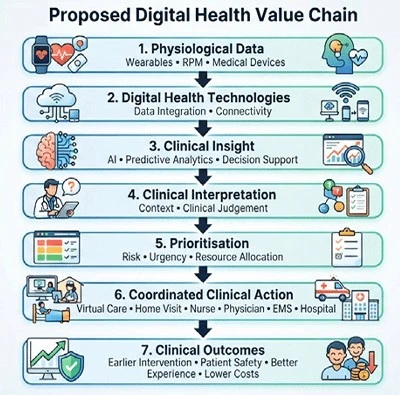
Inspired by Porter's value chain framework, digital health is best viewed as a continuous sequence of interconnected activities rather than a collection of independent technologies. Clinical value emerges from the effective integration of each stage of this pathway rather than from individual technologies alone (Figure 1).
The value chain begins with physiological data acquisition through wearable devices, remote patient monitoring systems, implantable sensors, smartphones, and hospital-based monitoring technologies. Artificial intelligence, predictive analytics, digital biomarkers, and clinical decision support systems transform these data into clinically meaningful insights. Healthcare professionals then interpret these insights within the patient's clinical context, prioritise them according to clinical urgency and available resources, and translate them into appropriate clinical action.
Coordinated clinical action may include patient education, virtual consultation, medication adjustment, referral to primary or specialist care, emergency medical response, hospital admission, or multidisciplinary management.
The process concludes with reassessment and follow-up to evaluate intervention effectiveness. Ultimately, digital health should be judged not by the number of alerts generated, but by its contribution to earlier intervention, improved patient safety, better clinical outcomes, enhanced patient experience, and more efficient use of healthcare resources. Taken together, these stages form a continuous pathway from physiological measurement to measurable patient benefit. Clinical value is created only when meaningful insight is consistently translated into coordinated clinical action.

The Transition between Insight and Action
Within the digital health value chain, one transition deserves particular attention.
Modern digital health technologies have become highly effective at identifying clinically meaningful events. Continuous monitoring platforms generate alerts, predictive algorithms estimate patient risk, and artificial intelligence increasingly detects physiological deterioration before it becomes clinically apparent.
Recognition alone, however, does not improve patient outcomes. Between identifying a clinically significant event and delivering effective care lies a sequence of clinical judgement, communication, prioritisation, multidisciplinary coordination, intervention, and follow-up. Although these activities are well established, they are often managed as separate clinical and operational processes rather than as consecutive stages of a single care pathway.
Consequently, the transition from clinical insight to coordinated clinical action represents a critical stage within the digital health value chain where clinical value may either be realised or lost.
This perspective does not propose replacing implementation science, care coordination, healthcare management, or clinical workflow optimisation. Instead, it suggests that these complementary domains can be viewed collectively as interconnected stages of the same healthcare process.
From this perspective, digital health extends beyond generating clinical insight to include the organisational capability required to translate that insight into timely, coordinated, and measurable patient care.
Future research should therefore evaluate not only how accurately digital technologies identify clinical deterioration, but also how effectively healthcare organisations respond once meaningful clinical information becomes available.
Ultimately, the value of digital health depends not only on the quality of data or predictive algorithms, but on the healthcare system's ability to translate insight into action consistently.
Discussion
The rapid evolution of digital health has shifted healthcare's principal challenge from generating clinical information to acting upon it effectively. Wearable devices, artificial intelligence, remote patient monitoring, and connected medical technologies now produce continuous streams of clinically relevant data with increasing accuracy and growing clinical acceptance.
Yet improvements in patient outcomes have not consistently paralleled these technological advances. This suggests that many of today's remaining barriers are organisational rather than technological.
The perspective presented in this paper argues that digital health should be evaluated across the complete pathway linking physiological measurement to patient outcomes.
Although sensing technologies, predictive analytics, implementation science, care coordination, and clinical workflow optimisation have each been extensively studied, they are commonly assessed independently despite functioning as successive stages within the same care process.
Improved outcomes are achieved not simply because deterioration is detected earlier, but because healthcare organisations consistently interpret clinical information, prioritise patients appropriately, coordinate available resources, deliver timely interventions, and evaluate their effectiveness.
This systems perspective complements existing implementation frameworks by emphasising that successful digital health depends on organisational execution as much as technological capability. As digital technologies continue to mature, differences in clinical outcomes may increasingly reflect how effectively healthcare systems translate insight into coordinated action rather than how accurately algorithms identify risk.
This broader perspective also has implications for evaluation. Traditional measures, including diagnostic accuracy, predictive performance, user engagement, and technology adoption remain essential, but they provide only a partial assessment of clinical impact. Future evaluations should also examine response time, prioritisation, multidisciplinary coordination, and follow-up as indicators of how effectively digital information is converted into measurable clinical value.
Digital health should therefore be viewed not as the endpoint of technological innovation, but as the beginning of a broader clinical process whose success depends equally on technology and healthcare delivery.
Conclusion
Digital health has fundamentally expanded healthcare's ability to generate clinically meaningful information. Continuous monitoring, artificial intelligence, and connected medical technologies now enable earlier detection of physiological deterioration and increasingly effective clinical decision support.
Recognition alone does not improve outcomes; coordinated clinical action does.
This paper proposes that digital health should be viewed as a continuous value chain extending from physiological data acquisition to measurable patient benefit. Within this chain, the transition from clinical insight to coordinated clinical action represents a critical stage that deserves greater attention in both research and healthcare practice.
Rather than introducing a new discipline, this perspective integrates established concepts from digital health, implementation science, care coordination, and healthcare operations into a unified systems view. Understanding how healthcare organisations transform clinical insight into coordinated action may complement technology-focused evaluations and provide a more comprehensive assessment of digital health performance.
As digital health technologies continue to mature, future progress will depend as much on organisational capability as on technological innovation.
Ultimately, the value of digital health will be determined not by the sophistication of its technologies, but by the ability of healthcare systems to consistently translate clinical insight into better outcomes for patients.
Future Research
Future research should evaluate not only the performance of digital health technologies, but also the organisational processes that translate clinical insight into measurable patient benefit.
This includes assessing the interval between clinical insight and intervention, identifying organisational factors associated with successful implementation, and evaluating how multidisciplinary coordination influences both clinical and operational outcomes.
Validation across hospitals, primary care, remote patient monitoring programmes, Hospital-at-Home services, and emergency medical systems will help determine whether evaluating the complete digital health value chain provides additional explanatory value beyond existing implementation frameworks.
Future studies may also establish measurable indicators for each stage of the value chain, enabling healthcare organisations to identify where clinical value is created—and where it is lost.
References
1. Topol EJ. Deep Medicine: How Artificial Intelligence Can Make Healthcare Human Again. New York: Basic Books; 2019.
2. Dorsey ER, Topol EJ. State of Telehealth. N Engl J Med. 2016;375(2):154–161. doi:10.1056/NEJMra1601705.
3. Greenhalgh T, Wherton J, Papoutsi C, et al. Beyond Adoption: A New Framework for Theorizing and Evaluating Nonadoption, Abandonment, and Challenges to the Scale-Up, Spread, and Sustainability of Health and Care Technologies. J Med Internet Res. 2017;19(11):e367. doi:10.2196/jmir.8775.
4. World Health Organization. Global Strategy on Digital Health 2020–2025. Geneva: World Health Organization; 2021.
5. World Health Organization. Ethics and Governance of Artificial Intelligence for Health. Geneva: World Health Organization; 2021.
6. American Medical Association. 2025 AMA Augmented Intelligence Research Physician Survey. Chicago, IL: American Medical Association; 2025.
7. Rajkomar A, Oren E, Chen K, et al. Scalable and accurate deep learning with electronic health records. npj Digit Med. 2018;1:18. doi:10.1038/s41746-018-0029-1.
8. Berwick DM. Era 3 for Medicine and Health Care. JAMA. 2016;315(13):1329–1330. doi:10.1001/jama.2016.1509.
9. Nilsen P. Making Sense of Implementation Theories, Models and Frameworks. Implement Sci. 2015;10:53. doi:10.1186/s13012-015-0242-0.
10. Proctor EK, Silmere H, Raghavan R, et al. Outcomes for Implementation Research: Conceptual Distinctions, Measurement Challenges, and Research Agenda. Adm Policy Ment Health Ment Health Serv Res. 2011;38(2):65–76. doi:10.1007/s10488-010-0319-7.
11. Spatz ES, Ginsburg GS, Rumsfeld JS, Turakhia MP. Wearable Digital Health Technologies for Monitoring in Cardiovascular Medicine. N Engl J Med. 2024;390(4):346–356.
12. Ginsburg GS, Picard RW, Friend SH. Key Issues as Wearable Digital Health Technologies Enter Clinical Care. N Engl J Med. 2024;390:1118–1127.
13. Porter ME. Competitive Advantage: Creating and Sustaining Superior Performance. New York: Free Press; 1985.
14. Porter ME. What Is Value in Health Care? N Engl J Med. 2010;363(26):2477–2481. doi:10.1056/NEJMp1011024.
15. Institute of Medicine. Crossing the Quality Chasm: A New Health System for the 21st Century. Washington, DC: National Academies Press; 2001.
Read the full article — it's free
Register with AmericanHHM to unlock expert insights, research articles and in-depth industry analysis.