

Hospitals today operate within increasingly complex healthcare ecosystems composed of three interdependent actors: patients, payors, and providers. Financial sustainability within this ecosystem is no longer driven solely by internal efficiency or service volume, but by how effectively financial expectations, incentives, and decision logic are aligned across these actors throughout the care journey.
Traditional hospital financial planning has historically emphasised budgeting discipline, cost containment, and service-line profitability. While these approaches remain necessary, they are increasingly insufficient in addressing ecosystem-driven financial risks. Among the most persistent challenges are billing complaints, reimbursement disputes, administrative escalation, and erosion of patient trust—many of which originate not from failures in clinical care, but from misalignment between patient expectations, payor policies, and provider operations.
Patients experience financial uncertainty when coverage, exclusions, or out-of-pocket obligations are unclear. Payors manage risk through complex eligibility rules, authorisation logic, and reimbursement conditions. Providers, particularly hospitals, are left to reconcile these differences operationally while delivering care. When alignment fails, hospitals absorb the consequences through increased administrative workload, delayed revenue realisation, and diminished patient loyalty.
This article argues that hospital financial planning must evolve toward integrated ROI systems that explicitly manage value across the patient–payor–provider ecosystem. ROI is reconceptualised not as a retrospective financial calculation, but as a healthcare management system that links revenue stability, complaint reduction, operational efficiency, and sustained patient engagement as direct, measurable outcomes.
Hospitals as the Governance Anchor of Healthcare Ecosystems
Within healthcare ecosystems, hospitals function as the operational, financial, and relational anchor connecting patients and payors. While payors define coverage structures and reimbursement logic, and patients make care decisions based on perceived affordability and fairness, hospitals execute care delivery and manage financial ambiguity at the point of service.
Patients rarely differentiate between provider and payor responsibilities when disputes arise. Billing disagreements, claim denials, and unexpected charges are typically attributed to the hospital regardless of the root cause. Consequently, hospitals bear disproportionate operational and reputational risk within the ecosystem.
From a healthcare management perspective, this positioning makes hospitals the natural locus for ecosystem coordination and governance. Financial planning therefore, cannot remain inward-looking. It must incorporate mechanisms for managing how patient expectations and payor decisions interact with provider workflows across the care continuum. Failure to manage this triadic relationship leads to increased complaints, administrative escalation, and weakened patient trust, outcomes that directly affect financial performance but are often excluded from formal ROI assessments.

Limitations of Conventional Financial Planning and ROI Models
Most hospital financial planning and ROI models are designed for internal investment evaluation. They focus on discrete projects such as infrastructure expansion, technology acquisition, or staffing optimisation, typically using short-term financial indicators.
While useful for capital allocation, these models are poorly suited to managing ecosystem- driven risk. Complaint-related and dispute-handling costs frequently remain invisible, absorbed into operational overhead rather than treated as financial variables. Revenue projections often assume frictionless reimbursement, overlooking delays, denials, and patient disengagement caused by financial uncertainty. Organisational accountability is fragmented, with finance, clinical leadership, and patient-facing teams operating in functional silos.
These limitations weaken the role of financial planning as a strategic management tool and reduce organisational resilience in increasingly complex healthcare environments.
Reconceptualising ROI Across the Patient–Payor–Provider Ecosystem.
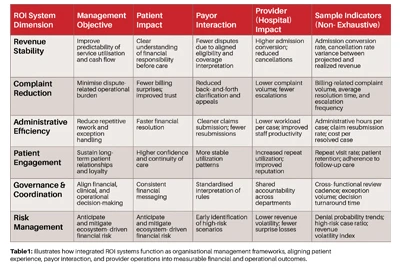
In ecosystem-based healthcare environments, ROI must reflect how value is created, preserved, and protected across organisational boundaries. Practical hospital experience demonstrates that ecosystem-aligned financial management produces four direct ROI outcomes that are managerially actionable.
Revenue Growth Through Improved Patient Conversion
Financial uncertainty remains a significant barrier to care utilisation. Even insured patients may delay or decline treatment when coverage eligibility or expected costs are unclear. Aligning financial expectations earlier in the care journey increases patient confidence, leading to higher admission conversion, fewer cancellations, and more predictable utilisation. From a management perspective, this represents direct revenue growth driven by ecosystem clarity.
Reduction in Complaint-Driven Costs
A substantial proportion of patient complaints originates from misalignment between payor decisions and patient expectations. Each complaint requires investigation, coordination, and resolution, consuming administrative resources and delaying revenue realisation. Proactive ecosystem alignment reduces complaint volume, shortens resolution cycles, and lowers escalation, resulting in direct cost avoidance and improved cash-flow predictability.
Reduced Administrative Workload and Operational Cost
Misalignment between clinical documentation, financial processes, and reimbursement rules generates repetitive administrative rework. When financial logic across patients, payors, and providers is addressed upstream, workload per case declines. Hospitals achieve structural efficiency gains without increasing staffing, representing direct operational ROI.
Sustained Patient Engagement and Long-Term Value
Financial trust strongly influences patient loyalty. Transparent and predictable financial experiences increase repeat utilisation, adherence to care plans, and positive referrals. Over time, sustained engagement enhances patient lifetime value and revenue resilience, positioning trust as a strategic financial asset.
Practice-Based Illustrations of Ecosystem-Aligned ROI Systems
While the framework presented is conceptual, it reflects recurring patterns observed across hospital implementations operating in complex patient–payor–provider environments.
I. A private tertiary hospital experienced frequent insured-patient cancellations due to uncertainty around coverage interpretation. Introducing structured pre-care financial clarification aligned with payor logic improved patient confidence and increased admission conversion, enhancing revenue predictability.
II. A multi-speciality hospital faced persistent billing complaints related to post-care reimbursement adjustments. By standardising financial communication and aligning documentation practices with payor requirements, complaint volume and administrative escalation decreased substantially.
III. In a high-volume insured setting, administrative teams were burdened by claim rework and manual clarification. Improved alignment between clinical data and Financial logic reduced exception handling and lowered workload per case without additional staffing.
IV. A mid-sized hospital observed higher return rates among patients who experienced transparent financial processes, reinforcing the link between financial trust, patient engagement, and long-term organisational value.
Managerial Interpretation of Ecosystem-Based ROI Outcomes
From a leadership perspective, the value of ecosystem-aligned ROI systems lies in their cumulative managerial impact. Revenue predictability improves when patient decisions and payor logic are addressed proactively rather than retrospectively. Complaint reduction stabilises operations by minimising unplanned escalation and managerial distraction. Administrative workload reduction releases organisational capacity, enabling scale and quality improvement without proportional cost increases. Importantly, sustained patient engagement acts as a long-term stabiliser within the ecosystem. When financial trust is established, patients demonstrate higher continuity of care and greater tolerance for system complexity. Together, these outcomes position integrated ROI systems as management control mechanisms, supporting coordinated governance across finance, operations, and patient-facing functions.
From ROI Calculation to Integrated ROI Systems
Capturing these outcomes consistently requires moving beyond project-based ROI toward integrated ROI systems embedded within hospital governance. Such systems provide visibility across patients, payor, and provider interactions and support proactive decision- making.
Key elements include standardised measurement of complaint-related and administrative costs, lifecycle-based ROI assessment reflecting long-term engagement, and cross-- functional governance linking finance, clinical operations, and patient services.
Conclusion
In patient–payor–provider healthcare ecosystems, hospital financial performance is shaped by alignment as much as by efficiency. Complaint-driven costs, administrative overload, and erosion of trust represent direct financial risks that traditional ROI models overlook.
Integrated ROI systems that manage ecosystem interactions enable hospitals to increase revenue, reduce complaint-related costs, lower operational workload, and sustain patient engagement. Reframing ROI as a healthcare management system positions hospitals to act as resilient anchors within increasingly complex healthcare ecosystems.