

The Hidden Risk in Healthcare Delivery
Healthcare systems across the world invest heavily in education, training, and continuing professional development. Despite this, a persistent and often under-recognised challenge continues to undermine these efforts. Knowledge decay, defined as the gradual loss of learned information over time, represents a systemic risk that extends beyond individual performance to affect organisational reliability, workforce stability, and patient outcomes. While training remains a foundational component of healthcare delivery, the durability of that training remains uncertain.
Why Knowledge Decays Over Time
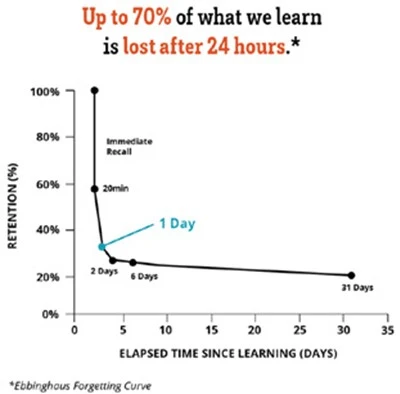
Evidence from cognitive science demonstrates that newly acquired knowledge declines rapidly in the absence of reinforcement. The work of Hermann Ebbinghaus first quantified this phenomenon through the “forgetting curve,” illustrating that memory retention decreases exponentially following initial exposure. Current research continues to support these findings, indicating that a substantial proportion of newly acquired knowledge may be lost within the first 24 hours without reinforcement, with retention continuing to decline sharply over subsequent days. For knowledge to support consistent performance, it must be consolidated over time through repeated reinforcement, enabling it to move from fragile initial recall into durable long-term retention. Structured reinforcement through spaced learning enables this transfer, sustaining retention at significantly higher levels and mitigating early-stage knowledge decay. This pattern reflects an inherent limitation of human memory rather than a failure of individual capability. In healthcare settings, the implications are magnified, as knowledge directly informs decisions made under conditions of uncertainty, time pressure, and limited opportunity for verification.
For knowledge to support consistent performance, it must transition from short-term memory into stable long-term retention through repeated reinforcement.
From Knowledge Loss to Clinical Variability
Rather than presenting as isolated failures, knowledge decay introduces subtle variability into clinical practice. Protocols may be followed in principle but not in precise execution. Critical steps may be delayed or omitted, not through negligence, but due to incomplete recall. Over time, these incremental inconsistencies accumulate, eroding the standardisation upon which safe and effective healthcare delivery depends. The resulting variability is often difficult to detect, yet it has meaningful implications for both clinical outcomes and operational performance.
This variability must be considered within the broader context of the mixture of experience in the workforce. Newly qualified or less experienced staff should primarily engage in mastering high-risk, high-frequency tasks that underpin routine clinical care. For these activities to be performed safely and efficiently, they must transition from strenuous recall to consistently retrievable long-term memory. In the absence of structured reinforcement, however, these competencies remain fragile, increasing dependence on supervision and elevating the risk of inconsistency in everyday practice. These challenges are further intensified in healthcare systems undergoing significant workforce transition. In the United Kingdom, for example, approximately one in five staff within the NHS are non-UK nationals, with substantially higher proportions in certain clinical professions, reflecting sustained reliance on internationally trained practitioners. This evolving workforce profile introduces variability in prior training, clinical exposure, and familiarity with local protocols. As a result, the standardisation of practice cannot be assumed and must be actively maintained through structured and continuous reinforcement mechanisms that support alignment and reduce unwarranted variation.
For more experienced professionals, repeated exposure ensures that high-frequency tasks are well established within long-term memory. The greater vulnerability lies in high-risk, low-frequency scenarios, including complex emergencies and rare clinical conditions. Because these situations are encountered infrequently, the associated knowledge is more susceptible to decay. When such events arise, however, the expectation for rapid and accurate response remains unchanged, creating a structural mismatch between operational demands and cognitive readiness, with potential implications for patient safety.
Workforce Complexity and System Pressure
At the team level, knowledge variability translates into inconsistency in the application of procedures and policies. When expectations are not uniformly understood, coordination becomes more complex and less reliable. Staff may interpret protocols differently, leading to inefficiencies, duplication of effort, and, in some cases, interpersonal tension. Over time, this inconsistency can erode trust, as individuals become uncertain about how colleagues will respond in critical situations. In high-pressure environments, such uncertainty can impede communication and diminish overall effectiveness.
These dynamics are further amplified in systems experiencing workforce pressures. Across Europe, staffing shortages, turnover, and increasing reliance on internationally trained professionals contribute to environments in which knowledge is continuously entering and leaving the organisation. This results not only in individual knowledge decay, but also in the gradual erosion of institutional knowledge. As continuity is disrupted, maintaining consistent standards of care becomes increasingly challenging, reinforcing the need for system-level approaches to knowledge retention.
Recognition of this issue is growing at both national and international levels. Within the NHS, workforce strategies emphasise continuous professional development, reflective practice, and the need for staff to remain current in their knowledge and skills. Similarly, the World Health Organization has highlighted the importance of maintaining workforce competence over time, noting that education alone is insufficient unless knowledge is retained and consistently applied in practice. These perspectives reflect a broader policy shift towards viewing competence as an ongoing organisational capability rather than a one-time achievement.

Implications for Teams, Systems, and Patient Experience
Traditional training models are not well aligned with this shift. Episodic approaches, including onboarding programmes and periodic certification, are effective for initial knowledge acquisition but less effective in supporting long-term retention. Information is frequently delivered in concentrated formats, often removed from the context in which it will be applied. Without structured reinforcement, much of this knowledge is lost, limiting the sustained impact of training initiatives.
The challenge is compounded by the cognitive demands of modern healthcare. Clinicians and staff must navigate increasing volumes of information, evolving clinical guidelines, and complex systems of care delivery. Cognitive load is high, and the capacity to retain information is finite. In such environments, knowledge that is not regularly reinforced is displaced by more immediate priorities, further accelerating the process of decay.
Importantly, the effects of knowledge decay extend beyond clinical roles. Healthcare delivery relies on the coordinated contributions of administrative staff, operational teams, and support personnel. These roles are essential to patient flow, communication, scheduling, and overall service delivery. When knowledge gaps exist within these functions, the impact may be less visible clinically but equally significant operationally. Inefficiencies, delays, and miscommunication can disrupt care pathways and contribute to variability in the patient experience. Improvements in staff coordination and consistency have been associated with measurable gains in patient satisfaction, underscoring the importance of shared understanding across all roles.
At a systems level, knowledge decay directly challenges the objective of achieving high reliability in healthcare delivery. High-reliability organisations depend on consistent execution, shared mental models, and minimal variability in critical processes. Knowledge decay undermines each of these elements by introducing inconsistency in how information is interpreted and applied. Even when policies and procedures are well designed, their effectiveness depends on uniform understanding across the workforce. Without ongoing reinforcement, this uniformity cannot be sustained.
The implications extend beyond safety to workforce wellbeing and organisational resilience. When knowledge is not consistently reinforced, uncertainty increases, particularly among less experienced staff or those working outside their usual scope of practice. This uncertainty contributes to cognitive strain, as individuals compensate for gaps in recall through increased effort, reliance on colleagues, or defensive decision-making. Over time, this additional burden may contribute to fatigue, reduced confidence, and increased stress, all of which are recognised contributors to burnout. In systems already experiencing workforce pressures, this creates a reinforcing cycle in which knowledge loss and workforce instability compound one another.
Rethinking Learning as a System Capability
Addressing this challenge requires a fundamental shift in how learning is conceptualised within healthcare systems. Rather than viewing training as a series of discrete events, there is a need to embed learning as a continuous organisational capability. This involves reinforcing knowledge over time, integrating learning into daily workflows, and aligning educational strategies with the realities of human memory and clinical practice. Evidence from cognitive science demonstrates that learning reinforced at structured intervals is significantly more likely to be retained and applied in practice, reducing variability and supporting more consistent performance across individuals and teams.
Approaches such as spaced learning, active recall, and adaptive reinforcement provide practical mechanisms to support this transition. By revisiting information at structured intervals and requiring individuals to retrieve and apply knowledge, these methods strengthen retention and improve accessibility in real-world contexts. Over time, they reduce unwarranted variation and support more consistent performance across individuals and teams.
The increasing use of data to inform learning strategies further enhances this capability. By identifying patterns of knowledge gaps and areas of risk, organisations can target reinforcement where it is most needed. This enables a more proactive approach to workforce development, shifting from reactive training models to continuous performance optimisation aligned with organisational objectives.
Knowledge decay should therefore be understood not simply as an educational issue, but as a systemic challenge that affects every level of healthcare delivery. Its impact can be observed in individual decision-making, team coordination, organisational reliability, and patient experience. Addressing it requires alignment across these levels, supported by strategies that recognise learning as an ongoing process rather than a one-time intervention.
As healthcare systems continue to evolve, the ability to ensure that knowledge is retained, accessible, and consistently applied will become a defining determinant of quality and safety. Embedding reinforcement into the fabric of daily practice offers a pathway to strengthen workforce capability, enhance system reliability, and deliver more consistent, high-quality care.
Up to 70% of newly acquired knowledge may be lost within the first 24 hours in the absence of reinforcement; however, structured reinforcement through spaced learning can sustain retention at levels exceeding 80%, substantially mitigating early-stage knowledge decay.
Implication: Reinforcement reframes training from a discrete intervention into a sustained organisational capability supporting consistent performance.
References (for online version only)
1. Ebbinghaus, H. (1913). Memory: A Contribution to Experimental Psychology.
2. Cepeda, N.J. et al. (2006). Distributed practice in verbal recall tasks. Psychological Bulletin.
3. Roediger, H.L. & Karpicke, J.D. (2006). Test-enhanced learning. Psychological Science.
4. Sweller, J. (1988). Cognitive load during problem solving. Cognitive Science.
5. NHS England (2019). The NHS Long Term Plan.
6. World Health Organization (2020). State of the World’s Nursing Report.
7. OECD (2023). Health Workforce and Retention Trends.
Read the full article — it's free
Register with AmericanHHM to unlock expert insights, research articles and in-depth industry analysis.