
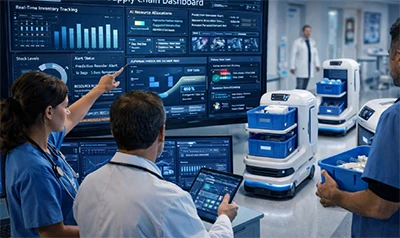
Hospital management increasingly recognises logistics as a strategic function rather than a purely operational activity. Logistics decisions affect not only cost structures but also quality of care, patient safety, and organisational performance. Hospitals manage complex flows of pharmaceuticals, medical devices, consumables, and equipment under conditions of uncertainty, regulatory pressure, and high service-level requirements.
Traditional hospital logistics systems are often characterised by fragmented processes, limited data integration, and reactive decision-making. These limitations contribute to stockouts, excess inventory, waste, and inefficiencies that directly impact clinical operations and financial outcomes. Recent global disruptions have further emphasised the vulnerability of hospital supply chains and the need for more resilient and intelligent logistics models.
Hospital Logistics 4.0 represents a managerial response to these challenges, integrating digital technologies and advanced analytics into logistics governance. Artificial Intelligence plays a central role in this transformation by enabling predictive, data-driven, and adaptive decision-making. This article analyses the strategic implications of AI for hospital management, focusing on efficiency, safety, and sustainability.
Hospital Logistics as a Strategic Function in Hospital Management
In contemporary hospital management, logistics has evolved from a traditionally operational support role into a strategic function that directly influences organisational performance, clinical quality, and financial sustainability. Hospital logistics decisions determine the availability of critical medical supplies, the efficiency of clinical workflows, and the institution’s ability to respond to uncertainty and demand variability. As a result, logistics is increasingly recognised as a core managerial domain aligned with strategic planning and value-based healthcare objectives.
From a strategic management perspective, hospital logistics integrates procurement, inventory management, internal distribution, supplier coordination, and regulatory compliance into a unified governance framework. These activities must be synchronised with clinical priorities, budgetary constraints, and patient safety standards. Ineffective logistics management can lead to treatment delays, increased adverse events, cost overruns, and reputational risk, while effective logistics enables continuity of care, operational resilience, and quality assurance.
A clear example of logistics as a strategic function can be observed in large tertiary hospitals managing high volumes of surgical procedures. In these settings, logistics is tightly linked to operating room scheduling. Advanced hospitals use integrated logistics and clinical planning systems to ensure that surgical instruments, implants, and sterile supplies are available exactly when required. This alignment reduces operating room downtime, improves utilisation rates, and enhances patient throughput. When logistics is managed strategically, it supports clinical productivity and directly contributes to revenue optimisation.
Another real-world example is pharmaceutical logistics in hospital pharmacies. Medication shortages represent a critical risk to patient safety and continuity of care. Hospitals that adopt strategic logistics management use centralised inventory visibility and predictive analytics to anticipate shortages, identify alternative suppliers, and prioritise distribution based on clinical criticality. During global supply disruptions, hospitals with mature logistics governance structures have demonstrated greater resilience by reallocating inventory across departments and adjusting treatment protocols in coordination with clinical leadership.
Hospital Logistics 4.0 further strengthens the strategic role of logistics by enabling digital integration and real-time information flows. Interoperable systems connect enterprise resource planning platforms with electronic health records, procurement systems, and supplier databases. This integration allows hospital managers to monitor inventory levels, consumption patterns, and supplier performance at an institutional level rather than in isolated departments. Logistics thus becomes a strategic information source for executive decision-making.
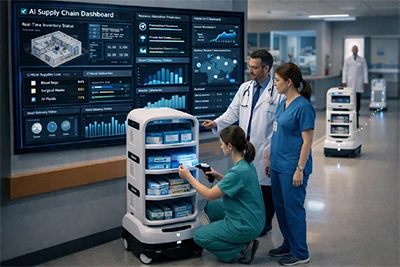
Artificial Intelligence enhances this strategic function by transforming data into actionable managerial insights. For example, AI-driven dashboards provide hospital executives with predictive indicators related to inventory risk, cost exposure, and service-level performance. Scenario analysis tools allow managers to simulate the impact of demand surges, supply interruptions, or budget constraints on logistics operations. These capabilities support proactive risk management and strategic contingency planning.
A further illustration of logistics as a strategic function is seen in hospitals pursuing value-based healthcare models. In such models, reimbursement is increasingly linked to outcomes rather than volume. Logistics plays a critical role by ensuring the efficient use of resources, reducing waste, and supporting standardised clinical pathways. For instance, hospitals implementing standardised care bundles for chronic disease management rely on coordinated logistics to ensure consistent availability of medical devices, diagnostic materials, and medications across care settings.
From an organisational perspective, the strategic elevation of logistics requires changes in governance structures. Many hospitals have created centralised supply chain management units reporting directly to executive leadership. This structural shift reflects recognition that logistics decisions have enterprise-wide implications affecting finance, clinical operations, and patient experience. Strategic logistics leadership also facilitates cross-functional collaboration between clinicians, finance teams, and information technology departments.
In summary, hospital logistics as a strategic function in hospital management goes beyond cost control and operational efficiency. It enables clinical excellence, supports patient safety, strengthens organisational resilience, and aligns logistics performance with long-term strategic goals. Hospital Logistics 4.0, supported by Artificial Intelligence, reinforces this strategic role by providing predictive capabilities, integrated governance, and data-driven decision support. Hospitals that treat logistics as a strategic management function are better positioned to navigate complexity, uncertainty, and increasing performance demands in modern healthcare systems.
Artificial Intelligence in Hospital Supply Chain Management
Artificial Intelligence has become a central driver of transformation in hospital supply chain management, enabling healthcare organisations to address increasing complexity, uncertainty, and performance expectations. Hospital supply chains manage highly heterogeneous flows, including pharmaceuticals, medical devices, consumables, diagnostic materials, and critical equipment, all under strict regulatory and safety requirements. Traditional management approaches based on manual planning, historical averages, and fragmented information systems are no longer sufficient to support effective hospital management.
From a managerial perspective, Artificial Intelligence enables hospital supply chains to transition from reactive and experience-based decision-making to predictive, data-driven governance. AI systems process large volumes of data generated across logistics operations, clinical activities, procurement processes, and external supply markets. By identifying patterns and correlations that exceed human analytical capacity, AI supports more accurate forecasting, faster response times, and improved strategic control.
A key application of AI in hospital supply chain management is demand forecasting. Machine learning algorithms analyse historical consumption data in combination with clinical variables such as patient admissions, surgical schedules, length of stay, and epidemiological trends. For example, large university hospitals have implemented AI-based forecasting tools to anticipate seasonal increases in demand for respiratory medications and personal protective equipment. By incorporating external data, such as public health surveillance reports, these systems allow hospital managers to proactively adjust procurement plans and avoid shortages during peak demand periods.
Another significant application is inventory optimisation. AI-driven inventory systems dynamically adjust reorder points and safety stock levels based on real-time consumption patterns and predicted demand. In hospital pharmacies, for instance, AI has been used to reduce expired medications by identifying slow-moving items and recommending redistribution across departments or affiliated hospitals. This strategic use of AI not only reduces waste and costs but also enhances medication availability for critical treatments.
Procurement and supplier management also benefit from AI integration. Advanced analytics evaluate supplier performance based on delivery reliability, lead times, quality incidents, and pricing variability. Hospitals with centralised supply chain management structures increasingly use AI-supported procurement platforms to identify optimal sourcing strategies and negotiate contracts. For example, AI systems can simulate the impact of supplier disruptions and recommend alternative sourcing options, supporting strategic risk management and supply continuity.
AI further enhances internal logistics and distribution within hospitals. Intelligent routing algorithms optimise the movement of supplies between warehouses, pharmacies, and clinical units, reducing delays and manual handling. In large hospital complexes, AI-supported automated guided vehicles and robotics systems are used to transport medications, linens, and sterile supplies. These solutions reduce staff workload, improve delivery accuracy, and free clinical personnel to focus on patient care.
Traceability and compliance represent another critical domain where AI delivers strategic value. By integrating data from barcode systems, RFID tags, and IoT sensors, AI enables end-to-end visibility of medical products throughout the hospital supply chain. Predictive analytics detect anomalies such as temperature deviations for cold-chain pharmaceuticals or discrepancies between prescribed and administered items. For example, AI-based monitoring systems in oncology units ensure that high-cost biologic drugs are stored and handled according to regulatory standards, reducing safety risks and financial losses.
From a hospital management perspective, AI-supported supply chain management also strengthens financial and strategic planning. Predictive cost analytics allow executives to anticipate budget impacts of demand fluctuations, price volatility, or regulatory changes. Scenario-based models support strategic decision-making by simulating different supply chain configurations and investment options. This capability is particularly valuable in public healthcare systems operating under strict budgetary constraints.
Despite these advantages, the adoption of AI in hospital supply chain management presents significant challenges. Data quality and interoperability remain major barriers, as hospital information systems are often fragmented and heterogeneous. AI solutions require standardised, accurate, and integrated data to generate reliable insights. Moreover, organisational readiness and skills development are critical factors. Supply chain professionals and hospital managers must understand AI outputs and limitations to effectively incorporate them into decision-making.
Ethical and governance considerations also play a central role. AI systems must operate within frameworks that ensure data privacy, transparency, and accountability. Hospital management is responsible for establishing governance structures that define decision authority, oversight mechanisms, and responsibility for AI-driven recommendations.
In conclusion, Artificial Intelligence fundamentally reshapes hospital supply chain management by enabling predictive, integrated, and resilient logistics systems. Through applications in demand forecasting, inventory optimisation, procurement, internal distribution, and traceability, AI supports hospital managers in achieving efficiency, safety, and sustainability objectives. When strategically implemented, AI transforms the hospital supply chain from a cost-driven operational function into a strategic asset that enhances organisational performance and patient-centred care

Inventory Optimisation and Demand Forecasting
Inventory management is one of the most critical and costly components of hospital logistics. Excess inventory ties up financial resources and increases the risk of expiration, while insufficient stock jeopardises patient care.
AI-driven inventory systems analyse historical consumption, clinical activity, seasonal trends, and external variables to forecast demand with greater accuracy. Unlike traditional static models, AI systems continuously adapt to changing conditions, allowing dynamic safety stock adjustments and automated replenishment.
For hospital management, the strategic benefits include:
• Reduced stockouts and emergency procurement.
• Lower inventory holding and obsolescence costs.
• Improved financial planning and cash flow.
• Stronger alignment between clinical demand and logistics supply.
Clinical Traceability, Risk Management, and Patient Safety
Traceability is a critical governance requirement in hospital management, particularly for pharmaceuticals, implants, and high-risk medical devices. Failures in traceability expose hospitals to regulatory sanctions, financial losses, and reputational damage.
AI enhances traceability by integrating data from logistics systems, electronic health records, and IoT-enabled devices. Predictive models identify anomalies in product flows, while real-time analytics enable rapid response to recalls or deviations in storage conditions.
From a management standpoint, AI-supported traceability strengthens:
• Patient safety and quality assurance.
• Regulatory compliance and audit readiness.
• Risk management and organisational accountability.
• Transparency across the healthcare supply chain.
Operational Efficiency and Cost Control
Hospital logistics typically accounts for a substantial share of operational expenditure. Inefficient processes, duplication of tasks, and lack of coordination increase costs and reduce organisational agility.
AI improves operational efficiency through workflow optimisation, intelligent routing, and automation of administrative tasks. Predictive maintenance reduces equipment downtime, while analytics-driven procurement supports strategic sourcing decisions.
For hospital executives, AI-driven logistics contributes to:
• Sustainable cost reduction.
• Improved productivity of logistics and clinical staff.
• Enhanced capacity to absorb demand variability.
• Reallocation of resources toward patient-centered care.
Sustainability and Environmental Responsibility in Hospital Management
Sustainability has become a strategic concern in hospital management, driven by regulatory frameworks, stakeholder expectations, and financial considerations. Logistics activities significantly influence hospitals’ environmental footprint.
AI supports sustainable logistics by minimising waste, optimising transportation routes, and reducing overstocking. Advanced analytics also facilitate monitoring of environmental performance indicators aligned with Environmental, Social, and Governance (ESG) objectives.
Integrating AI into sustainable hospital logistics enables:
• Reduction of material waste and emissions.
• Compliance with sustainability regulations.
• Cost savings through resource optimisation.
• Strengthening of institutional reputation and social responsibility.

Managerial and Organisational Challenges of AI Adoption
Despite its potential, AI adoption in hospital logistics presents managerial challenges. Data fragmentation, legacy systems, and lack of interoperability limit the effectiveness of AI solutions. Additionally, organisational resistance and skills gaps hinder implementation.
Hospital management must address ethical concerns related to data privacy, algorithm transparency, and accountability. Governance frameworks and change management strategies are essential to ensure trust and adoption among stakeholders.
Successful implementation requires:
• Strategic leadership and executive sponsorship.
• Investment in data governance and digital infrastructure.
• Training programs for logistics and clinical teams.
• Human centered AI integration supporting professional judgment.
Strategic Implications for Hospital Management
AI adoption in hospital logistics should be framed as a strategic transformation initiative. Hospital leaders must align AI investments with organisational objectives, patient safety priorities, and value-based healthcare models.
Strategic planning should emphasise scalability, interoperability, and measurable value creation. Cross-functional collaboration between management, logistics, IT, and clinical leadership is critical to maximise benefits.
Hospitals that effectively integrate AI into logistics governance are better positioned to enhance resilience, improve performance, and maintain competitiveness in increasingly complex healthcare environments.
Conclusion
Hospital Logistics 4.0 represents a critical evolution in hospital management, positioning logistics as a strategic driver of efficiency, safety, and sustainability. Artificial Intelligence enables hospitals to transition from reactive logistics models to predictive, integrated, and resilient supply chains.
This article demonstrates that AI-driven hospital logistics delivers significant managerial value through improved inventory management, enhanced traceability, cost control, and environmental responsibility. However, realising these benefits requires strong leadership, robust governance, and organisational readiness.
For hospital management, AI is not merely a technological innovation but a strategic asset that supports long-term sustainability, quality of care, and organisational excellence.
References
Christopher, M. (2016). Logistics and supply chain management (5th ed.). Pearson.
Ivanov, D., & Dolgui, A. (2020). Viability of intertwined supply networks: Extending the supply chain resilience angles towards survivability. International Journal of Production Research, 58(10), 2904–2915. https://doi.org/10.1080/00207543.2020.1750727
Kelle, P., Woosley, J., & Schneider, H. (2019). Pharmaceutical supply chain specifics and inventory solutions for a hospital case. Operations Research for Health Care, 23, 100188. https://doi.org/10.1016/j.orhc.2019.100188
Rai, A., Constantinides, P., & Sarker, S. (2019). Next-generation digital platforms: Toward human–AI hybrids. MIS Quarterly, 43(1), iii–ix.
World Health Organisation. (2020). Medical supply chains and logistics in health systems. WHO Press