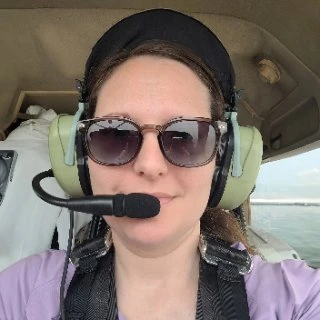
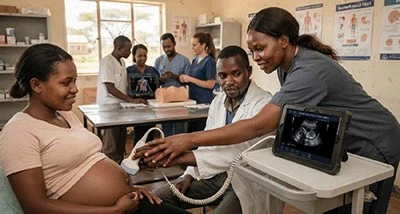
Q: What first inspired you to begin teaching ultrasound in low resource settings?
My journey began in Jamaica, long before I understood how profoundly global ultrasound education would shape my life. I was volunteering in an A&E department, having brought a portable ultrasound machine with me. One patient had been lying in the emergency department for three days. The clinicians feared she had cancer, with a large abdominal mass and no imaging to clarify what was happening
I scanned her with the machine I had carried in my luggage. Within minutes, it was clear: she did not have cancer. It was a large uterine fibroid. The relief on her face and on the faces of the clinicians is something I will never forget. She was discharged home that day.
That moment changed me. It showed me that ultrasound is not simply a diagnostic tool; it is a lifeline. It can alter a clinical pathway, restore hope, and prevent unnecessary suffering. It was the first time I truly understood the power of imaging access and the injustice of its absence.
Ultrasound is uniquely positioned for global health: portable, radiation free, and able to answer critical clinical questions in real time, even in the most resource constrained environments.
Q: You’ve worked across eight countries. How did these environments differ, and what did they teach you?
Each country taught me something different, and each shaped my understanding of global imaging in its own way.
In Greece, at an international medical conference, my colleagues and I recognized a glaring gap: clinicians in low resource settings needed structured ultrasound education, not sporadic workshops. That realization led us to create a volunteer led global ultrasound education initiative — a foundation that shaped my later work.
In Thailand, I learned the value of structure and discipline in training. The clinicians’ methodical approach pushed me to refine my own teaching style, making me more deliberate as I structured their skill development and reinforced technique. Their precision reshaped how I think about pacing and mastery.
Spain taught me cultural humility. The clinicians had deeply established professional identities, and teaching required sensitivity to those norms. It reminded me that global health is not defined solely by scarcity but by understanding the values and expectations of the people you teach.
In Kenya, I experienced the beauty and unpredictability of fieldwork. When the internet cut out, we moved outside and hung sheets from trees to block the sun. As we scanned, monkeys climbed through the branches, curious and unbothered. It was chaotic, joyful, and unforgettable.
In Gabon, I learned resilience of a different kind, arriving in a tiny plane that dropped me in the middle of the jungle — a moment that underscored how remote some clinical environments truly are and reminded me how often global health requires adapting quickly, trusting the unknown, and moving forward even when the path is unclear.
In Papua New Guinea, I learned that safety looks different in every setting. As a woman, I was advised not to walk the streets alone. That guidance reminded me that global health requires humility and trust in local wisdom.
In Jamaica, I saw the realities of care delivery in settings without the infrastructure we take for granted. There were no patient armbands, no bedsheets changed between patients, no cloths to wipe ultrasound gel, and no private rooms — only open wards. It was truly “bush work”: no regulations, no accreditation standards, and no large scale imaging systems like CT or MRI. Yet the clinicians were resourceful, compassionate, and determined.
In the United States, I became aware of inequities within my own system. Working internationally sharpened my understanding of how access varies in high resource environments.
Across all eight countries, one truth remained constant: clinicians everywhere want to provide excellent care. What varies is the support they receive.
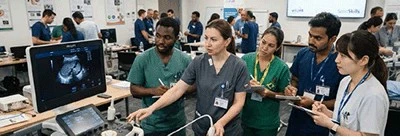
Q: What surprised you most during your global ultrasound work?
I was surprised by how quickly clinicians could integrate ultrasound into their practice when training was contextualized to their environment. In Papua New Guinea, midwives were identifying life threatening obstetric conditions within days of hands on teaching.
I was also struck by how much clinicians wanted reassurance not because they lacked skill, but because they had never had structured training or consistent access to functioning equipment. Many simply needed someone to confirm that they were interpreting images correctly or that their technique was sound.
I was also surprised by how quickly communities themselves responded. In several countries, once people heard we were teaching ultrasound, locals lined up to be scanned as volunteers often because it might be their only chance to check their health. Their patience and hope reminded me how deeply people value even a single moment of clarity about their own health.
Fieldwork also brought moments I could never have anticipated. During one long drive in Kenya, the roads were so rough that pieces of the car kept falling off. Each time we heard a clatter, the driver laughed and said, “Lost another part! Oh well, no biggie.” His calm acceptance of the journey taught me a great deal about resilience and perspective.
Another day, traffic came to a complete standstill. After some time, we realized that drivers had left their vehicles to salvage meat from a giraffe that had been struck on the road. It was a practical response to food insecurity a reminder of how communities make use of every available resource.
In Gabon, I once needed to leave a remote site, only to have the pilot quietly admit that his license had expired. I found a driver who spoke no English, and I spoke no French. We drove eight hours together, finding a common language in 90s dance music on the radio. At one point, he returned from a shop with a Sprite and said, “Here is your orange juice.” It remains one of my favorite memories a reminder that connection often transcends language.
These moments taught me that global health is as much about navigating unpredictability as it is about clinical skill.
Q: What were some of the biggest challenges you encountered?
The challenges were rarely technical. They were human, structural, and systemic.
In many places, X ray machines existed but were broken sometimes for years. There were no biomedical engineers, no service contracts, and no spare parts. Ultrasound became the only viable imaging modality.
Handheld ultrasound devices were transformative because they bypassed infrastructure barriers. But clinicians often lacked confidence. Many were afraid they were “doing it wrong.” Some did not know what normal looked like, because they had never seen it. In the United States, people often struggle to recognize abnormal findings. In low resource settings, clinicians often struggle to recognize normal ones. I encouraged them to scan each other, their colleagues, and their families. Normal anatomy became their foundation.
Another challenge was equipment inconsistency. Machines were often donated old, mismatched, and without manuals. Clinicians did not know how to access hidden features or adjust settings. Sometimes, simply showing them how to optimize depth or gain transformed their confidence.
Daily life also shaped the rhythm of training. In Jamaica, our driver told me he went home each night to rebuild his house because it was perched on a hill and slid a little farther down every evening. His determination mirrored the resilience I saw in the clinicians and people doing everything they could with what little they had.
In Papua New Guinea, being advised not to walk alone as a woman required me to adapt my movements, my schedule, and my expectations. It was a reminder that global health work is not only about clinical skill it is about navigating unfamiliar environments with humility and respect.
One of the most profound moments occurred in Papua New Guinea when we scanned a young woman who had never started her period. The ultrasound revealed that she had no uterus a diagnosis that was life altering for her. In her community, motherhood carries deep cultural significance, and she expressed fear about what this meant for her future. It was a powerful reminder that imaging does not only answer clinical questions; it can profoundly shape a person’s identity, hopes, and sense of belonging.
But one of the greatest challenges was ensuring sustainability. Training only matters if clinicians can keep strengthening their skills long after the initial sessions end.
Q: How did you approach sustainability in your training programs?
Sustainability begins with humility. Instead of arriving with a predetermined curriculum, I asked clinicians what they needed most. In Kenya, that meant focusing on obstetric emergencies. In Spain, it meant refining musculoskeletal techniques. In Jamaica, it meant strengthening foundational scanning skills.
I also teach clinicians to see every part of every organ themselves and to confirm, with their own eyes, whether what they are seeing is normal or abnormal. For sonographers, this skill is tied to producing perfect images for radiologists who are not present in real time — they must “prove” the finding through the image.
For doctors in low resource settings, the workflow is different. They are both the scanner and the interpreter. They do not need to prove it to a radiologist; they need to prove it to themselves. That difference shapes how I teach each group.
We also built local champions — clinicians who could continue teaching after the initial training. In Papua New Guinea, one midwife became the regional ultrasound resource. Watching her confidence grow was one of the most rewarding experiences of my career.
Q: What role does cultural humility play in global ultrasound education?
Cultural humility is essential. It means recognizing that I am entering someone else’s clinical world, not bringing them into mine.
In Greece, I learned to navigate the complexities of refugee care. In Thailand, I adapted to a culture that values structure and hierarchy. In Jamaica, humor and warmth built trust quickly. In Kenya, flexibility was everything especially when monkeys interrupted training sessions.
Humility also means acknowledging that clinicians know their patients, their community, and their constraints better than I ever could. My role is to support, not to impose.
Q: How has this work shaped your understanding of imaging equity?
It has shown me that imaging equity is not only a global issue — it is a local one. Even in the United States, access varies dramatically by geography, socioeconomic status, and institutional resources.
Equity requires more than equipment. It requires training, maintenance, workflow support, and systems that value diagnostic accuracy. It requires listening to clinicians who understand the barriers their patients face.
Q: What advice would you give to clinicians or leaders seeking to expand imaging access in their own settings?
Start with people, not machines. Identify clinicians who are eager to learn and invest in their development. Build training programs that reflect local realities rather than importing models from elsewhere.
And recognize that progress takes time. Sustainable change is built through relationships, consistency, and shared purpose.
Q: What do you hope readers take away from your experiences?
I hope readers see that imaging access is not an abstract concept. It is a lived reality that affects clinical decisions every day. I hope they recognize the value of investing in people in their training, their confidence, and their ability to provide high quality care regardless of setting.
This work reshaped how I teach, how I lead, and how I understand the role of imaging in both global and local health systems. It strengthened my belief that leadership in global health begins with listening to clinicians, to communities, and to the realities that shape their work.
Most of all, I hope readers understand that global health is a collective effort grounded in humility, respect, and the belief that every patient deserves the dignity of an accurate diagnosis.
Read the full article — it's free
Register with AmericanHHM to unlock expert insights, research articles and in-depth industry analysis.