
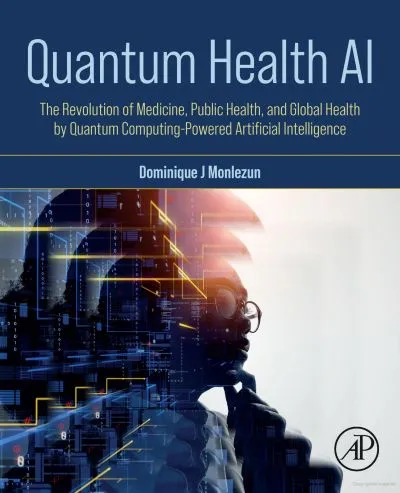
1. In Quantum Health AI, you explore the fusion of quantum computing and artificial intelligence in global health. How do you see this integration reshaping medicine and public health in the next decade?
Quantum-powered AI will either be the greatest technological boost—or threat—to medicine and public health, as they apply our most disruptive hardware and software to humanity’s most critical strategic asset: our health. Health workers, policymakers, and leaders are therefore indispensable for advocating for our patients by helping steer the responsible design and deployment of these technologies. Healthcare is far too expensive and inaccessible for most people globally, while fielding too few health workers. But quantum AI may allow us to scale efficient and effective innovations to reverse these trends.
2. Quantum AI presents unprecedented opportunities, but also risks of centralization and inequity. How can policymakers and global institutions ensure these technologies are developed and deployed ethically and equitably?
We cannot ensure they will be (since a small group of countries and companies are advancing these technologies faster than any regulation or legislation). But what we can do is be the force multipliers for equitable value-based care, by working with policymakers and institutions crafting and enforcing global AI governance for health, and so the guardrails for this global tech race maximizing mutual benefit and minimizing societal harms. We can also co-design the local governance frameworks synced with our existing clinical workflows and research portfolios that already are showing promise and widescale adoption (i.e., the TRAIN consortium and the World Health Organization’s responsible health AI).
3. Your book emphasizes a "human-centered approach" to Quantum AI in healthcare. What core principles should guide the responsible integration of these technologies into medical practice?
Instead of just another list of principles we put up on walls, this approach is about rediscovering the essential principle: each patient loved as a unique person in community. When we recover our shared understanding across cultures, belief systems, and health systems that we belong to each other, and that the individual good and common good cannot be achieved without each other, then we can re-earn trust in each other through productive cooperation toward the full flourishing—aka integral wellbeing or health—of all. Like in human-centered economics, household living standards, not just GDP, are needed. So too in quantum health AI, human security and data security are both critical.
4. You discuss the strategic competition between democracies and autocracies in the race for Quantum AI. How do geopolitical factors shape the development and application of these technologies in global health?
Political economics are the meta-determinants of health, shaping and constraining to a large extent the biological, social, commercial, and digital determinants of health. And the leading powers globally have both defined quantum and AI as critical national security assets that will determine our future. Health workers and leaders with our technology partners can therefore reinforce positive pressure on them to collectively manage this strategic competition so patients worldwide benefit from the resultant innovation (i.e. ChatGPT and DeepSeek making each other better), while minimizing its weaponization and conflict. Cooperate where we can, compete where we must.
5. The ethical challenges of AI in medicine are already complex. How does the addition of quantum computing further complicate the landscape of AI ethics in healthcare?
Quantum simplifies and complicates the ethical challenges AI poses for healthcare. Quantum simplifies them by limiting the number of powerful actors driving this computing revolution forward (currently among a handful primarily of American and Chinese companies), so it facilitates the traditional institutional checks on their competition. But it also complicates the challenges by enabling decentralized breakthroughs that can fundamentally and unpredictably redefine the global digital ecosystem on which health innovations depend (such as by quantum increasingly threatening standard digital encryption on which our health data exchanges depend).
6. You highlight the need for a balance between human security and national security in Quantum AI governance. How can governments foster innovation while preventing misuse or unintended consequences?
Human security ethically and pragmatically reinforces guardrails in the strategic competition for national security, in which there is an intensifying global technology race to dominate quantum AI. Consider how a healthcare system may want to expand its reach and profit margin through greater organizational efficiencies (but this also invites the financial risks of over-expansion and increased regulatory scrutiny). Similarly, it is in the interests of all governments to foster collaborative innovation according to a globally shared minimum set of fair rules that benefits all of humanity (while minimizing risks from rogue or irresponsible actors).
7. Your research spans multiple disciplines, from physics to bioethics. How do you envision interdisciplinary collaboration playing a role in advancing Quantum AI for global health?
Quantum AI for global health is an inescapably inter-disciplinary enterprise. And the winners are those who leverage more comprehensive insights to drive faster innovation, not just technically with more efficient performance, but also institutionally with greater public trust and so use. Science, economics, and ethics must work together. More free, open, and collaborative ecosystems outcompete their more controlled, closed, and divisive counterparts in the quantum health AI R&D, governance, and thus market share.
8. The book discusses the role of biotechnology companies in shaping the Quantum AI revolution. What responsibilities should these companies have in ensuring their technologies benefit all populations, not just high-income countries?
The demographic decline (and even collapse) in many high-income countries means the producers and consumers of quantum AI must increasingly come from—or at least partner with—low- and middle-income countries. China and the United States are currently competing not just technically for quantum AI but also politically for preferential partnerships with these emergent powers. Whoever’s companies deliver greater value (higher quality for lower cost), defined as more transparently and equitably safe, efficient, and effective, ultimately wins.
9. Quantum AI has the potential to revolutionize disease prevention, diagnostics, and treatment. What are some of the most promising real-world applications already emerging in healthcare?
Like washing hands as one of our most powerful anti-infection tools in hospitals, many of the most promising quantum AI advances are simple but fill key gaps. Leading use cases include digital platforms (more quickly and affordably expanding health systems’ AI and computing capacities especially in lower resource communities), federated data architectures (accelerating precision medicine and precision public health), swarm intelligence, AI agents, cloud and edge computing, quantum safe cryptography, digital twins, in-silico (digital) trials, translational meta-multi-omics, micro-nanorobots, and clean or green AI.
10. Public trust in AI-driven healthcare remains fragile, especially in marginalized communities. What strategies can be used to build transparency and trust in Quantum AI-powered health systems?
Fair and transparent ‘co-design’ is gaining traction in responsible AI creation and deployment, especially through public-private partnerships such as with large technology companies working with trusted non-government organizations and local health systems to ensure patients and providers can inform every step of the quantum AI cycle. Then health wins beget new wins and can strengthen trust, deepen collaboration, and scale applications through more of the health ecosystem.
11. You mention that Quantum AI could transform global health governance. What institutional changes would be necessary to integrate this technology into existing healthcare systems without exacerbating disparities?
Many health organizations worldwide are making the right changes (because they have no other choice if they want to stay open). The World Health Organization and others are doing important work on top-down governance. Meanwhile, bottom-up governance is happening much more rapidly and probably more influentially as health systems are having to show greater transparency, responsiveness, and efficiency delivering on local health demands (especially as more disruptive technology companies such as through smartphone apps can leapfrog brick-and-motor traditional health players if they fall too far behind delivering patient value).
12. As Quantum AI progresses, concerns about data privacy and security become more pressing. How can healthcare institutions safeguard patient data while leveraging the power of these technologies?
Federated data architectures like with Mayo Clinic’s Platform and TriNetX in America and the Ayushman Bharat Digital Mission in India provide powerful examples of advancing innovation without jeopardizing security. Swarm learning and globally scalable quantum safe cryptography, such as with IBM’s z16 quantum-safe mainframe with on-chip AI, in addition to Nvidia’s health platforms, also show what ‘Data-Behind-Glass’ models can do in this area trying to keep data as secure and local as possible, while sharing quantum AI-generated insights across network partners.
13. Many fear that AI will replace human decision-making in medicine. How do you see the role of physicians evolving in a Quantum AI-powered healthcare landscape?
The need for physicians has only increased as medicine becomes more technologically advanced: better science means more data in which patients can get more easily lost. Healthcare systems upskilling physicians with responsible AI will replace systems and physicians without such AI. Our role as healers stays constant, but our toolbox expands with this technology to better serve patients (especially with the accelerating trend of quantum AI democratization as with digital platforms and AI embedded in clinical workflows).
14. Your book presents a call to action for using Quantum AI to advance humanity’s health and future. What immediate steps should researchers, policymakers, and healthcare professionals take to move towards this vision?
Go hold the hand of your closest patient and listen to their story. They will help us prioritize which quantum AI applications, capacities, and infrastructures are the greatest value-add for them, while keeping us rooted in why we are doing all this in the first place. And weekly meet one new person outside your discipline and background. They help us translate old insights into new breakthroughs in our niche, while improving the scale, scope, speed, and sustainability of a shared actionable strategic plan toward a healthier, fairer, more human future.