As the world advances, new technologies are transforming healthcare – enabling faster, more efficient care and helping meet the demands of an aging population. Artificial intelligence (AI) and machine learning (ML) are becoming vital tools, allowing healthcare providers to diagnose and treat more effectively and with greater speed.
Yet in many rural and underserved areas, these innovations remain out of reach. Limited access to electricity, education, and medical infrastructure means that tools and services must be adapted to local conditions. Healthcare solutions in these settings need to be simple, reliable, and resilient.
Remote diagnostics and expert supervision offer a powerful way to bridge this gap. They can provide patients with access to high-quality care – regardless of location – even when specialists are not physically present. This is crucial not only in rural communities and low-resource countries, but also in conflict zones and remote environments such as offshore platforms.
In this article, I share a real-world experience from a visit to Ghana, where we are working to establish a remote ultrasound supervision platform. This system is designed to be used anywhere – from isolated villages and urban clinics without ultrasound experts, to extreme settings like the Arctic or oil rigs – bringing expert care closer to the patient, wherever they are.
A Global Divide in Diagnostics
Health care diagnostics and treatment options are advancing rapidly. Each day brings new opportunities to detect and treat illnesses earlier and more effectively. But while this progress is celebrated in urban hospitals and well-funded health systems, many people in rural and low-resource areas are still being left behind.
In large parts of the world, even basic diagnostic tools – like CT scanners, MRIs, or standard blood testing – are either unavailable or unusable due to lack of infrastructure or trained personnel. The result is a troubling gap in early detection and access to treatment.
But with the rise of point-of-care technology, artificial intelligence (AI), and remote diagnostics, that gap can be closed – bringing life-saving capabilities directly to communities that need them most.
Field Experience: Training and Technology in Ghana
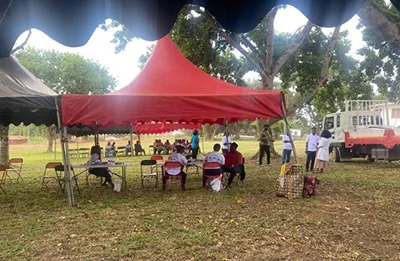
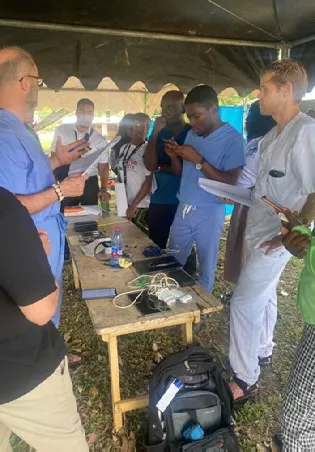
I recently traveled to Ghana with the Rural Health Foundation, a private non-profit health organization focused on improving rural health care through Point-of-Care Ultrasound (POCUS). Our mission was not just to provide care temporarily, but to train local physicians in using ultrasound technology as part of their regular practice.
By equipping and educating local doctors, the impact of our work extends far beyond our visit. One of our ultrasound specialists is even pursuing a PhD exploring how remote supervision and training can further support providers using POCUS in rural settings – adding another layer of sustainability to the approach.

Listening to Local Voices
In Ghana, we met many enthusiastic doctors eager to learn and improve their diagnostic skills. They welcomed donations of equipment and medicines from abroad but shared how these generous contributions can sometimes miss the mark when disconnected from local realities.
At one hospital, a state-of-the-art CT scanner was donated – but when plugged into the local power grid, it shut down the entire hospital. Without the proper infrastructure to support it, the machine now sits idle and rusting. Meanwhile, the hospital still relies on a decades-old X-ray machine that works reliably within their power limitations.
In contrast, the handheld ultrasound devices we used were easily charged, highly portable, and practical for bedside or even outdoor use. They proved to be a far more effective tool in this context.
Safe, Accessible, and Empowering
One of the greatest strengths of POCUS and remote diagnostic tools is their simplicity and safety. They’re non-invasive, can be used anywhere, and – when properly taught – can be operated by a wide range of healthcare workers. But responsible use is essential.
POCUS should not be used indiscriminately or as a general screening tool. It should be guided by symptoms and clinical findings, and the user must understand basic anatomy to differentiate between normal variations and pathology. Every patient is unique, and what looks unusual on a scan might be completely harmless in a healthy person.
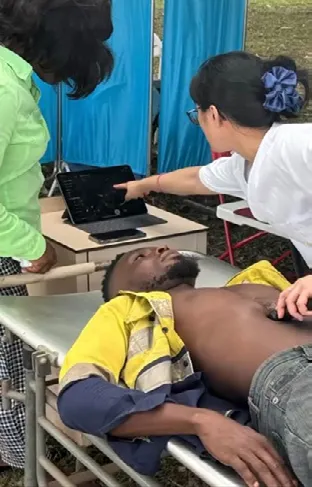
During our visit, a Norwegian team member introduced Ghanaian doctors to a remote supervision platform, enabling local physicians to perform scans with real-time expert support. These doctors – who know the culture, language, and communities – are now equipped to carry on the work, supported when needed by international expertise.
This is the only sustainable way to build up health systems in rural areas: by empowering local providers with knowledge, tools, and confidence.
The Simplicity of the Setup
The technology required is surprisingly basic. All it takes is a handheld ultrasound scanner, internet access, and a two-way audio-video communication link. That’s it. With these, expertise can be extended to the most remote locations on Earth – opening the door to more equitable health care for all.
As global populations grow, health systems everywhere are feeling the strain. In many places, patients must travel long distances to reach specialists or hospitals. But with point-of-care devices and remote supervision, more patients can be diagnosed and treated locally – reducing travel costs, speeding up care, and avoiding unnecessary hospitalizations.
This is not just for rural Africa or Asia. Even in developed countries like Norway and the United States, local care providers – such as general practitioners, elderly care homes, or ambulance teams – could use these tools to perform diagnostics at the point of need. In emergencies, paramedics could conduct ultrasounds en route to the hospital, transmitting images to specialists for immediate decision-making.
Beyond Ultrasound: A Broader Transformation
While our fieldwork focused on POCUS, similar remote approaches are being adopted in other areas of medicine. ECGs taken in ambulances are now routinely transmitted to hospitals for cardiologists to assess in real time, enabling faster triage for heart attack patients.
However, these tools must be used wisely. The quality of diagnostics depends on the equipment, the user’s training, and the clinical context. Technology should enhance – not replace – clinical judgment. For instance, the rise of full-body scans, genome analysis, and broad-spectrum blood tests can overwhelm both patients and providers with irrelevant or misleading data. Statistically, even healthy individuals will have out-of-range test results that may not indicate illness.
Machines and AI are valuable aids, but they can’t interpret the emotional nuance of a patient’s story or substitute for clinical reasoning. They are only as good as the people who design and use them.
Looking Ahead: Smart Systems, Not Just More Staff
With aging populations and increasing pressure on health systems, the need for more healthcare professionals is clear – but equally urgent is the need for smarter, more efficient tools. It’s not enough to simply scale up staffing. We must scale up capability, deploying high-quality diagnostic devices beyond urban hospitals and into rural clinics, health posts, disaster zones, and resource-limited environments.
These tools must be intelligent, accessible, and designed for the realities of frontline care. That means integrating AI, ML and remote connectivity to support decision-making, enable real-time supervision, and reduce diagnostic delays – regardless of geography.
AI will not replace good doctors. But healthcare professionals who learn to work with AI will become more efficient, more consistent, and more capable. By combining the clinical intuition of humans with the data-driven precision of machines, we can offer more accurate, timely, and equitable care – not just for some, but for everyone, everywhere.
This isn’t a distant vision. Around the world, pioneering teams are already implementing remote ultrasound platforms, smart triage tools, and AI-assisted diagnostic systems. We are not just imagining the future of healthcare—we are actively building it.
One scan, one connection, and one empowered provider at a time. And this is just the start, there are many other diagnostic tools that could be remote, so that local healthworkers that know the culture and the people can do the work they know best, and experts can help with special diagnostics.
The future is made together.