
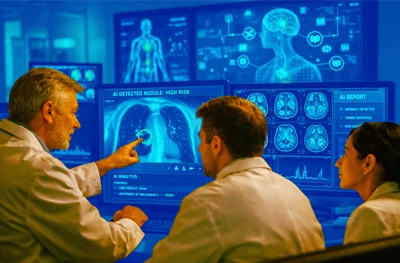
In this article, we explore current use cases of artificial intelligence (AI) in radiology and highlight its potential future developments. Our approach places the patient at the center, organising the use cases around the patient journey.
Radiology is a critical clinical service that supports accurate diagnosis and effective treatment by providing clinicians with essential medical imaging insights. Through modalities such as MRI, CT, X-ray, ultrasound, and nuclear medicine, radiology supports the patient throughout the diagnostic journey from scheduling and image acquisition to reporting and follow-up studies. As this journey becomes increasingly complex, AI is being integrated at each stage to improve efficiency, optimise resources, enhance diagnostic accuracy, and ensure timely communication of results.
Artificial intelligence is built on machine learning algorithms, and its level of maturity depends on both the volume of data used for training and the relevance of that data to the specific clinical use case.
AI in prevention
Prevention scanning is an area of potential growth where the population is scanned to detect early signs of a disease, which can help cure the patients.
One familiar example is the breast cancer screening where the female population over a certain age are scanned to detect any breast cancer.
Today, this screening is done in some countries every year, in other countries every couple of years, for the whole female population. AI can be used here to narrow the targeted population to those who have a higher risk of breast cancer and to limit the unnecessary scans to the population with a lower risk of breast cancer.
By maturing AI, we will be able to have higher percentages of patients cured because of early detection, and at the same time, avoid scanning the low-risk citizens.
AI in patient scheduling
When clinicians request radiology services for the patient, the patient is usually directed to the radiology modality for scanning. If the patient is an outpatient, then the patient will visit a hospital or radiology center to do the scanning based on his/her insurance coverage, and if the patient is inpatien,t he/she will be directed to the radiology modality in the same hospital.
Today, AI is used in a limited scope to make sure the patient is scheduled to the right facility with the right modality, which suits the clinician’s request, however, usually there is waste in the process by overbooking, long wait time, and staff unavailability.
AI tomorrow will be mature enough to make the right patient scheduling (right hospital, right modality, right day and time slot) and will also make sure the examination is reported properly within the acceptable turnaround time.
This future maturity needs collaboration between all the care givers and having a central scheduling algorithm which monitors the overall utilisation of the radiology modalities in a specific area or geographical zone.
AI in patient positioning
When patient is in the radiology department and admitted to the scanner (MRI, CT, US or X-Ray) he/she needs to be positioned correctly for the scan, and in advanced scan types clinicians and technologists need to make sure all the terminal devices connected to the patients are connected properly so that probability of wrong scans or false results is minimum to zero.
In addition to this, the protocols selected to scan the patients need to be the right protocols to make sure there will be no need to repeat the scans, which are costly and consume time from the machine utilisation for other patients.
Today AI is partially used in all the above, there are still some gaps which can cause mistakes in positioning of the patient or selecting the scan protocols, those mistakes are frequent and lead to less machine utilization, more patient uncomforting and some times it causes delay in the exam as patient may need to come in another day for fresh exam after making the pre-exam preparation.
Tomorrow, AI will be mature enough to eliminate wrong scans, AI will make sure all exams are done first time right, AI will give audible messages to the operator in case of wrong positioning or protocol selections before the scan, the human factor will be minimal, and the scans will be done first time right.
AI in patient comfort
Patient comfort looks like a luxurious statement; however, it is not as in long scans on some radiology modalities like MRI, if the patient is not feeling comfortable, he cannot stay for 30-45 minutes or more inside the scanner to perform the examination.
Today, there are tools that can be used by the operators to give comfort to the patients inside the scanner when doing the examination, these tools include the ambient experience and some entertainment programs.
Tomorrow, AI will master this area by personalising the patient experience. The in-bore and out-bore patient experience will be tailored based on his/her preferences. AI will be able to know the patient and determine his/her preferences to make sure the examination is done with the highest possible level of comfort to the patient which will help in making the examination correctly.
AI in image acquisition
This area is one of the most mature use cases of AI in radiology today, where AI is used in the image acquisition phase for many different purposes, it can be used in CT examinations to reduce the dose to the patient, it can be used in MRI examinations to accelerate the examination time without compromising the image quality, it can be used in oncology to generate CT images from MRI examinations, and many other similar use cases in the image acquisition phase.
Tomorrow, AI will be more matured and the computing power of the modality reconstructors will be much bigger than today.
This means more accelerated scans without any compromise in image quality, all routine MRI examinations will be done in a few minutes, and the generation of different images from one modality will be more common.
This will be a big leap in AI use in radiology, as it will give access to more patients to the radiology services by making the scans super-fast, it will reduce harmful dose to the patients and produce images with much higher image quality than today’s images.
AI in image interpretation
This is another area of mature use cases of AI in radiology today, where AI is used in the image interpretation, as per today’s limitation in the computing power of the reconstructors of the radiology modalities and due to the big amount of data generated in one patient scan with technologies like photon counting CT, due to those reasons: AI algorithms available today are vertical algorithms covering sub-specialities.
Those AI algorithms, like chest X-Ray, Prostate MRI, Breast Mammography and others, those AI algorithms are mature in those vertical areas.
While no computing power today is available to cover all the specialities in one algorithm, in other words, no AI algorithm is available today to interpret one image from all the specialities.
The use of AI algorithms in image interpretation today is linked to the PACS systems, and radiologists will use AI algorithms as part of the reporting workflow in the hospital or radiology centre.
Tomorrow, AI will be able to cover all the specialities in one go because of the leap in computing power that will enable a reconstructor with the ability to handle a huge amount of data for post-processing and interpretation.
Worth to note that this tomorrow’s leap in AI use in image interpretation will not replace the radiologists’ jobs, but it will help the radiologists to make more precise reporting and avoid any false interpretation.
AI in radiology reporting
AI is used today in reporting by providing a quick template with the proper patient data filled into the report and by helping to relate the report to the images.
However, there is no single standard way of reporting or template for reporting, and the mix between AI and humans in radiology reporting today is not as successful as it should be.
Tomorrow, the blended AI/human radiology reporting will mature, and the language of the report will see some changes from being extremely conservative as per today’s human practice to more reasonable and conclusive reporting.
The medicolegal perspective will remain important and considered however, the confidence of the findings will be much higher, which will make the vocabulary of the radiology reports more conclusive and less vague.
Conclusion
AI is used today in radiology in many aspects with different levels of maturity and different levels of commercial acceptance.
Tomorrow, AI will get more mature with more data in the machine learning models, and with more computing power capabilities with quantum computing, this will make a big leap in the radiology service by making it faster, more conclusive, accessible for more patients, less human dependant, more standardized.
At this point, we need to mention a common impression in the industry that radiologists today (not all of them, of course, but maybe most of them) are reluctant to the use of AI in radiology, especially in image interpretation and reporting, and this reluctance is mainly driven by the fears of AI replacing radiologists in the future.
There is no final word in this impression yet, but it is worth mentioning that the radiology service is understaffed in almost everywhere globally, and the demand is much higher than the number of qualified and trained radiologists available. This makes AI a very good tool to help bridge the gap between demand and the availability of radiologists.
Tomorrow will come with a lot more patient centricity and empowerment.