Musculoskeletal (MSK) health is a major and growing health issue on both sides of the Atlantic, putting seismic pressure on health services and costing the economy billions in both the UK and the USA. In the US alone, MSK problems account for more than 50% of all disabling health conditions, primarily driven by lower back pain and joint issues. The economic burden is equally substantial, with MSK diseases costing the US economy approximately $380.9 billion each year and affecting more than a third of the US population.
In the UK, MSK conditions are a similarly pervasive challenge, affecting around 20.8 million people and accounting for roughly one in every five primary care physician or family doctor appointments. Despite high demand and significant economic impact, the two countries have taken markedly different approaches to managing MSK care pathways, largely due to structural differences in the respective health systems.
The US system, driven by private insurance and a payer structure, is fragmented. Its multiple entry points and providers mean that inconsistent triage services can also delay appropriate, timely intervention. In contrast, the UK’s NHS operates as a centrally coordinated, publicly funded system, with more standardised care pathways.
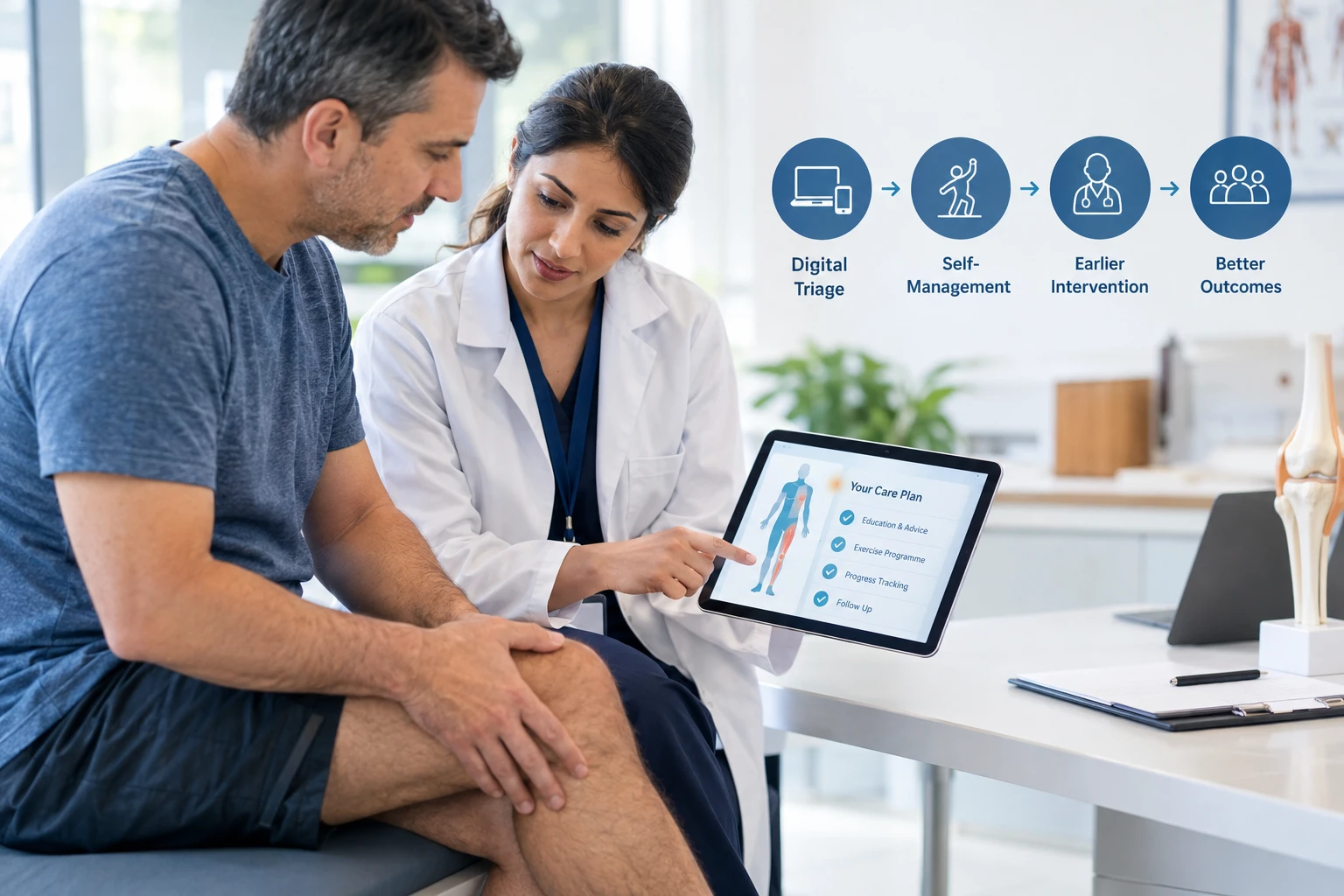
Emerging evidence from pilot work in the NHS suggests that redesigning integrated MSK care pathways can yield significant results, with digital platforms speeding up triage, providing structured self-management, and reducing pressure on secondary care services whilst improving access and patient outcomes.
This raises the question of what the US can learn from the innovative work underway in the NHS in the UK. And how can this make a significant and lasting difference to how the debilitating effects of MSK are treated and managed in one of the biggest health markets in the world?
Learning from the NHS: How digitally enabled MSK can change care pathways in practice
Two recent pilots, NHS Shetland and Sandwell and West Birmingham NHS Trust, clearly illustrate how these models can expand access to care and improve patient outcomes.
For the remote rural communities in Shetland, geography presents a fundamental barrier to accessing care. To improve the accessibility of care available to their patients, NHS Shetland and the Shetland Health and Care Partnership piloted a digital MSK platform. The outcomes provided an interesting illustration of how digitally enabled, pathway-level triage can both overcome access challenges while maintaining clinical effectiveness.
Over 12 months, 512 individuals aged 18-85 years accessed the service. As part of the assessment, 74% of patients were deemed suitable for self-management and 75% of patients using the platform required no further MSK treatment beyond the self-management support they received. This example starkly illustrates how a large proportion of MSK demand can be effectively managed without additional onward referrals when patients receive appropriate triage and support.
The model's flexibility also proved critical, with around half of all usage occurring outside traditional clinic hours. This reflects a shift toward more accessible, patient-centred care that fits around work and daily life, which is particularly important in rural and remote settings.
A similar pattern has been seen at Sandwell and West Birmingham NHS Trust, which serves a diverse population of 340,000, albeit in a very different geographical context and with a different patient demographic. Before the introduction of the digital MSK platform, it was facing acute MSK service pressures during and following the COVID-19 pandemic. These included the classic challenges of long waiting times, diminished clinical capacity, and a growing backlog of referral cases. As with many trusts, these logistical challenges place considerable strain on already stretched clinical teams and create an urgent need for a more scalable and sustainable approach to tackling the problem.
The implementation of a digital MSK platform enabled a shift toward self-referral, early triage, and more efficient use of clinical resources.
The operational impact was significant, as the platform freed up 1,240 hours of clinical time, enabling clinicians at the trust to refocus their efforts on patients with more complex or urgent needs. It has also manifested in an eight-week reduction in waiting times, helping the Trust move closer to NHS England’s elective care targets, a key metric on which their performance was assessed. Patient satisfaction was also very high, with 80% of those surveyed rating the service as good or very good.
These two pilots clearly evidence the potential of digitally enabled MSK solutions to improve existing treatment pathways and help hospitals use limited clinical resources more effectively. While the cases represent different underlying challenges, ranging from urban service backlogs to geographical isolation, they demonstrate an important overarching principle. Namely, that early triage, supported self-management, and pathway integration can fundamentally reshape how MSK demand is managed at scale across diverse areas with different service challenges.
For the US, where MSK care remains fragmented across providers and payers, these NHS case studies offer a clear proof point for a different healthcare model. When digital MSK tools are integrated into a service in a coordinated, structured way, it is possible to reallocate a large proportion of service demand. This has the effect of freeing up resources, removing unnecessary referrals and aligning clinical capacity with more complex patient needs. There is an opportunity for the US to create a more integrated MSK care system by redesigning its current care pathway to be more coherent.
This is not purely a hypothetical model. In the Australian workers' compensation market, shifting from reactive claims management to zero-day digital triage and supported self-management has already helped a large employer avoid over AU$339,000 in workers' compensation claims and cut triage times by up to 85%, delivering more than a 14-fold return on the programme's cost.
For US employers and payers, this points to a similar commercial opportunity: offering employees low-cost access to digital triage and self-management, backed by early in-person care where needed, structured so it does not create a co-pay barrier to entry. Applied at scale, this is the same principle already driving the NHS deployments above; early, well-triaged intervention reduces the number of cases that become complex, protracted, and costly.
Making it happen in the states: Learning the right lessons
Translating lessons from the UK’s digital MSK pathways into the US is not, and will never be, a process of like-for-like replication. Doing this right requires an understanding and appreciation of the structural differences that shape how care is delivered and paid for.
Delivering this change at scale is challenging because the US system is defined by payer fragmentation and a diverse range of reimbursement mechanisms that are often misaligned with provider incentives. Patients continue to enter the healthcare system through multiple uncoordinated access points, making consistent triage and pathway management more difficult in practice.
These challenges, although significant, should not blind us to real opportunities to deliver MSK care differently in the US. Integrated delivery networks (IDNs) and larger payer organisations provide a viable means of delivering scalable solutions. Some providers are already investing in digital front doors and care navigation, creating a potential entry point for MSK triage. For employers, this is a no-brainer and makes economic sense. MSK-related issues are widely acknowledged as a key driver of employee absenteeism and reduced workplace productivity. So, there’s a clear business case for investing in tools that enable earlier intervention and proactive management of MSK.
The US value-based care model has the potential to catalyse change in this space. In a system where reimbursement is tied to outcomes rather than overall patient numbers, there are stronger incentives to adopt treatment pathways that enable early intervention.
The inconvenient truth for US healthcare: It's about the system, not just the technology
However, it is important to acknowledge that these solutions are all too often used as a single point of access within employer health schemes, rather than as part of an integrated, end-to-end, system-wide care pathway. If there’s one thing the UK model shows us, it's that greater impact comes from greater co-ordination. There needs to be genuine alignment between digital MSK tools and existing clinical workflows, as well as with referral management systems and wider capacity management across the system.
There is an opportunity to rethink the current US MSK care model by embedding digital triage tools into a structured care pathway that guides patients from their first point of contact through to treatment resolution. Applying this approach could shift the system away from isolated interventions towards system-level change, unlocking the benefits already seen in the NHS.
The enduring lesson from the NHS is about the necessity of aligning digital technology within the wider healthcare system. For the US healthcare market, the temptation will be to treat digital MSK tools as yet another 'point solution' or a plug-in for corporate wellness; however, doing so misses the point entirely. The true opportunity lies in using these platforms as a unifying thread between different systems and providers.
To truly realise the benefits seen in the Shetland and Sandwell NHS pilots, US payers will need to move beyond digitising individual interactions and instead re-engineer the pathway itself. The next step requires courage to build a system that finally puts the patient pathway, not the siloed provider, at the centre.
References:
1. https://newsroom.cigna.com/10-stats-on-musculoskeletal-conditions-in-the-united-states
2. https://consultqd.clevelandclinic.org/musculoskeletal-disease-causes-most-disability-healthcare-spending-in-u-s-but-gets-less-than-2-of-nih-research-funds
3. https://www.england.nhs.uk/elective-care/best-practice-solutions/musculoskeletal/
4. https://ukhsa.blog.gov.uk/2019/03/11/why-are-musculoskeletal-conditions-the-biggest-contributor-to-morbidity/
5. https://www.eql.ai/blog/nhs-shetland-extends-partnership-with-eql
6. https://www.eql.ai/blog/transforming-msk-care-at-sandwell-and-west-birmingham-nhs-trust-with-phio

Peter Grinbergs is the Chief Medical Officer and Co-founder of EQL. A former Premier League physiotherapist and serial entrepreneur, he has successfully built and scaled three healthcare companies. With a strong commitment to improving access to high-quality healthcare, Peter advocates for the use of intelligent technology to enable a shift from reactive treatment to proactive, personalised care. At EQL, he is focused on advancing this vision through innovative, technology-driven healthcare solutions.