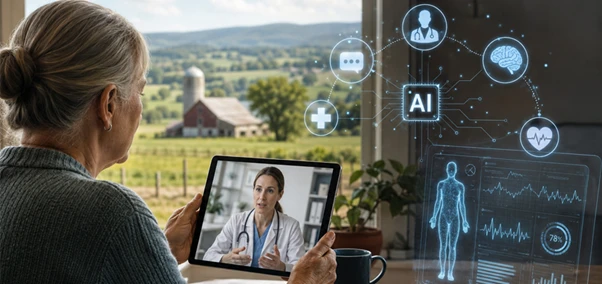
Telehealth and AI are reshaping rural healthcare by closing long-standing gaps in access and outcomes. Virtual care, remote patient monitoring, and clinical decision support now bring specialist-level care to underserved areas, while broadband limitations, digital literacy, and reimbursement policy remain key challenges. As infrastructure improves, hybrid, AI-driven care models promise stronger rural patient outcomes ahead.
Introduction:
If you've ever driven two hours just to see a doctor, you already understand the problem rural healthcare has been quietly wrestling with for decades. Nearly 46 million Americans live in rural areas, yet many of these communities have lost hospitals, clinics, and specialists at an alarming rate over the past twenty years. Into this gap has stepped a combination of two forces that are finally starting to close the distance between patients and providers: telehealth and artificial intelligence.
Telehealth in rural healthcare isn't just a pandemic-era convenience anymore. It's becoming the backbone of how small towns and farming communities access everything from routine checkups to specialist consultations. And when you pair it with AI, the results start to look less like a stopgap and more like a genuine transformation of how care gets delivered outside major cities.
Let's dig into what's actually working, what's still broken, and where all of this is headed.
Why Rural Healthcare Needed a Fix in the First Place
Before we talk solutions, it helps to understand the scale of the problem. Rural hospitals have been closing at a pace of roughly 10 to 15 per year over the last decade. When a hospital shuts down, it doesn't just remove a building — it removes obstetrics units, emergency rooms, and often the only source of specialist referrals for a hundred miles in any direction.
Add to that a chronic shortage of physicians willing to practice in low-population areas, longer travel times for basic care, and higher rates of chronic disease among rural populations, and you get a recipe for worse rural patient outcomes across nearly every measurable category — heart disease, diabetes management, maternal health, and mental health treatment among them.
This is the backdrop against which telehealth and AI have started to matter so much.
How Telehealth Is Closing the Distance
At its core, rural telemedicine does one simple thing extremely well: it removes travel from the equation. A patient in a town with no cardiologist can now have a video consultation with one based three states away. A nurse practitioner running a small clinic can loop in a specialist in real time during an exam. Mental health counseling, which used to require driving to the nearest city, can now happen from a kitchen table.
This shift toward virtual care has proven especially valuable for:
The result isn't just convenience — it's measurable improvement in healthcare accessibility, which has long been the single biggest barrier rural patients face.
Where AI Enters the Picture
Telehealth handles the "how do I reach a doctor" problem. AI is increasingly handling the "what should we do about it" problem.
AI in rural healthcare is showing up in ways that are genuinely practical, not just flashy. Predictive algorithms can flag patients at risk of a cardiac event before symptoms even appear, based on patterns in their vitals and history. Triage chatbots can help patients figure out whether a symptom needs an ER visit or can wait for a scheduled telehealth appointment — a genuinely useful tool when the nearest ER is an hour away.
Perhaps the most impactful application is clinical decision support. Rural clinics often operate with generalist staff who have to make calls across dozens of specialties in a single day. AI tools that flag drug interactions, suggest diagnostic pathways, or highlight abnormal lab trends give these providers a second set of eyes — effectively giving a small-town clinic some of the diagnostic depth of a large hospital system.
Then there's remote patient monitoring (RPM), which pairs beautifully with AI. Wearable devices and at-home sensors track blood pressure, glucose levels, oxygen saturation, and heart rhythms, feeding that data into systems that flag anomalies automatically. Instead of a patient waiting three months for a follow-up, a care team can be alerted the moment something looks off. For rural patients managing chronic conditions, this kind of continuous oversight can mean the difference between a manageable adjustment and an emergency hospitalization.
The Real Barriers: It's Not All Smooth Sailing
None of this works, though, without a foundational piece of infrastructure that a lot of rural America still doesn't have reliable access to: internet.
Broadband in rural healthcare is arguably the single biggest limiting factor on everything discussed above. According to the FCC, millions of rural households still lack access to broadband speeds sufficient for stable video consultations. You can build the most sophisticated AI diagnostic tool in the world, but it's useless if the clinic's internet connection drops every time it rains.
Beyond connectivity, a few other real challenges persist:
Digital literacy gaps. Many rural patients, particularly older adults, aren't comfortable navigating apps or video platforms, which means telehealth adoption often requires hands-on training, not just access.
Reimbursement uncertainty. Telehealth billing policies have shifted repeatedly since 2020, and rural providers — often running on thin margins — need predictable reimbursement rules to justify investing in new technology.
Data privacy and trust. Rural communities can be understandably wary of AI-driven tools handling sensitive health data, especially when they don't fully understand how that data is used or protected.
Workforce readiness. Training rural clinical staff to work alongside AI tools takes time, and many small practices don't have the bandwidth for extensive retraining.
None of these problems are unsolvable, but they do mean that the promise of digital health solutions in rural America is still very much a work in progress rather than a finished product.
What's Coming Next
Looking ahead, a few trends are shaping where healthcare technology in rural settings is headed:
Hybrid care models are becoming the norm rather than the exception — a blend of in-person visits for hands-on exams and telehealth for everything else, coordinated through a single digital record.
AI-powered triage and scheduling will likely become standard in rural clinics, helping short-staffed teams prioritize the sickest patients first and reduce unnecessary ER visits.
Federal and state broadband investment continues to expand, with programs specifically targeting healthcare infrastructure in underserved counties. As connectivity improves, so will the reliability of every telehealth and RPM tool built on top of it.
Predictive, personalized medicine powered by AI will move from pilot programs into mainstream rural practice, particularly for managing chronic conditions like diabetes and heart disease where early intervention makes an outsized difference.
Community health worker integration is also gaining traction — pairing local, trusted community members with telehealth technology to bridge both the trust gap and the digital literacy gap in one move.
Frequently Asked Questions
Does telehealth actually improve outcomes for rural patients?
Yes. Studies consistently show that rural telemedicine reduces missed appointments, improves chronic disease management, and shortens the time between symptom onset and treatment — all of which directly improve rural patient outcomes.
What role does AI play in rural clinics specifically?
AI mainly supports clinical decision-making, predictive risk flagging, and remote monitoring — essentially giving smaller, generalist-staffed clinics access to diagnostic support that would normally require a specialist on-site.
Why is broadband such a big deal for rural healthcare?
Because virtual care, remote monitoring, and AI diagnostic tools all depend on stable internet access. Without reliable broadband, even the best digital health solutions can't function consistently.
Is telehealth a permanent fixture or a temporary fix?
It's increasingly permanent. Reimbursement policy is still catching up, but adoption trends and infrastructure investment both point toward telehealth becoming a standard part of rural care delivery rather than a stopgap.
The Bottom Line
Telehealth and AI aren't magic fixes for rural healthcare's deep-rooted challenges — hospital closures, provider shortages, and infrastructure gaps don't disappear overnight. But together, they represent the most meaningful shift in rural care delivery in a generation. As broadband access expands and AI tools mature, the gap between what a patient can access in a major city and what they can access in a small farming town is finally starting to narrow.
For millions of people who've spent years driving hours just for basic care, that shift can't come soon enough.
.webp)
Kate, Editorial Team at American Hospital & Healthcare Management, leverages her extensive background in Healthcare communication to craft insightful and accessible content. With a passion for translating complex Healthcare concepts, Kate contributes to the team's mission of delivering up-to-date and impactful information to the global Healthcare community.