Psychological safety in healthcare helps staff speak up, report errors, and question decisions without fear. This article explains how psychological safety connects to patient safety, why emotional intelligence is the leadership skill that builds it, and offers seven practical steps, clear communication examples, and measurement tips for busy healthcare leaders.

Introduction:
Every hospital has people who notice problems early: the unclear handover, the odd lab value, the colleague who looks exhausted. The real question is whether they feel safe enough to say so. In teams where speaking up feels risky, small concerns stay silent until they become serious incidents.
This is why psychological safety in healthcare matters, and why emotionally intelligent leadership is the key to building it.
What Is Psychological Safety in Healthcare?
Psychological safety in healthcare is the shared belief that you can speak up with a question, concern, mistake, or disagreement without being punished, embarrassed, or ignored.
Harvard professor Amy Edmondson, who introduced the concept in the 1990s, found something surprising in hospital research. The best teams didn’t report fewer errors. They reported more, because people felt safe naming them. Teams that hid mistakes simply learned nothing from them.
Psychological safety doesn’t mean being nice all the time, lowering standards, or avoiding hard feedback. It means high standards and high trust, where people can say “I’m not sure,” “I think I made a mistake,” or “I disagree” without fear.
Why Psychological Safety and Patient Safety Go Hand in Hand
Most serious patient safety events don’t come from one person’s incompetence. They come from small signals that someone saw and didn’t voice: an unclear handover, a skipped checklist step, a worry about a colleague’s fatigue.
Here is how psychological safety and patient safety connect:
Fear is expensive in healthcare. When people stay silent to protect themselves, patients carry the risk.
How Emotional Intelligence Fits In
If psychological safety is the climate, emotional intelligence is the weather-maker.
Emotional intelligence in healthcare leadership is a leader’s ability to recognize and manage their own emotions, read the emotions of others, and respond in ways that build trust. Psychologist Daniel Goleman popularized the framework, and its core skills map neatly onto clinical leadership.
1. Self-awareness. Do you know how you come across during a code, a crisis, or a bad shift? A leader who sighs, rolls their eyes, or goes cold may not realize the team reads it as “don’t bring me problems.”
2. Self-regulation. Healthcare is full of pressure. Emotionally intelligent leaders stay steady, so their stress doesn’t become everyone else’s fear.
3. Empathy. This means noticing that the new graduate is overwhelmed or that the veteran nurse is quietly burning out, and responding before it becomes a resignation letter.
4. Social skill. This is the ability to give feedback, resolve conflict, and communicate clearly across doctors, nurses, allied staff, and patients’ families.
Emotional intelligence for healthcare leaders isn’t a soft extra. It’s the mechanism through which psychological safety is created or destroyed, one interaction at a time.
How to Create Psychological Safety in Healthcare (7 Practical Steps)
You can’t announce psychological safety in a memo. It’s built through repeated behavior. Here’s how to start creating psychological safety in healthcare teams.
1. Go first with your own mistakes
When a leader says, “I got that wrong, here’s what I learned,” it gives everyone else permission to be human. Silence from leaders teaches silence to teams.
2. Respond to bad news with curiosity, not blame
The first 10 seconds after someone admits an error set the tone for the next 10 months. Try “Thanks for telling me. Walk me through what happened” instead of “How did this happen?”
3. Ask for dissent directly
Don’t ask, “Any questions?” People usually say no. Ask, “What are we missing?” or “What’s the biggest risk in this plan?” Specific invitations get specific answers.
4. Thank people for speaking up, publicly
If a nurse flags a near miss, recognize it. Rewarding the messenger is the fastest way to get more messengers.
5. Flatten the hierarchy during critical moments
Use structured tools like pre-procedure briefings, huddles, and “stop the line” authority, where anyone can pause a procedure if something looks wrong, regardless of rank.
6. Separate accountability from blame
A just culture distinguishes human error, at-risk behavior, and reckless conduct. Most incidents are system failures. Treating them as personal failures guarantees they’ll be hidden next time.
7. Protect time for reflection
Short post-shift debriefs (“What went well? What nearly went wrong? What should we change?”) normalize learning as part of the job.
Healthcare Leadership Communication: What Actually Works
Healthcare leadership communication is where emotional intelligence becomes visible. Small word choices shape whether people feel safe.
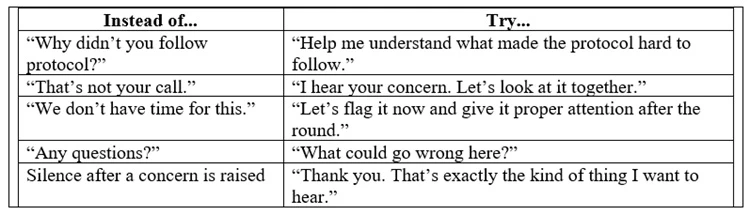
Three habits make the biggest difference:
Common Mistakes Leaders Make
Even well-meaning leaders slip into patterns that quietly erode safety:
How Do You Know It’s Working?
You can’t fix what you don’t measure. Simple ways to gauge psychological safety in healthcare teams include:
Review results together, and act on them. A survey with no follow-up is another way of not listening.
Frequently Asked Questions
What is psychological safety in healthcare?
It is a team climate where staff feel safe to ask questions, admit mistakes, and raise concerns without fear of punishment or humiliation, so problems are caught before they harm patients.
How does psychological safety improve patient safety?
When people feel safe speaking up, errors and near misses surface early, communication during handovers improves, and teams can fix system problems before they cause harm.
What is the role of emotional intelligence in healthcare leadership?
Emotionally intelligent leaders manage their own reactions, notice how their team is feeling, and communicate with empathy. That’s what makes staff feel safe enough to be honest.
How can healthcare leaders build psychological safety?
Model vulnerability, respond to mistakes with curiosity, invite dissent, thank people for speaking up, use structured briefings, and follow through on concerns raised.
Can psychological safety be measured?
Yes. Validated survey questions, incident-reporting patterns, retention data, and meeting observation all offer useful signals.
The Bottom Line
The people on your team already see the problems: the unclear handover, the odd lab value, the exhausted colleague. Whether they tell you depends on thousands of earlier moments. How you reacted to their first question. Whether a colleague’s mistake was met with learning or shame. Whether anyone ever said, “I want to hear when something feels off.”
Psychological safety in healthcare isn’t a trend or an HR slogan. It’s a patient safety strategy, and emotional intelligence is how leaders build it.
Start small this week: admit one mistake out loud, thank one person for raising a concern, and replace one “Any questions?” with “What are we missing?” Culture changes one conversation at a time.

Sarah Richards, a member of the Editorial Team at American Hospital & Healthcare Management, uses her extensive background in healthcare communication to create clear and engaging content. With a strong commitment to making complex healthcare topics accessible, Sarah helps the team achieve its goal of delivering timely and impactful information to the global healthcare community.