The OYD framework empowers patients by transforming fragmented health data into a unified, secure, and accessible asset. Through governance, unified architecture, and data literacy, OYD enables transparency, faster results, and preventive care. It strengthens trust, enhances decision-making, and positions patients as active partners in their health journey.
Healthcare is undergoing one of the most profound transformations in modern history. The convergence of technology, data, and human care has redefined how people experience medicine, not as passive recipients of information, but as active participants in their well-being. In this context, Own Your Data (OYD) emerges as more than a framework; it is a philosophy that restores agency, transparency, and trust to patients.
In a world where every health record, exam, or diagnostic image tells a story about a person’s life, the ability to access, understand, and use that information becomes fundamental. Patients increasingly expect not only quality medical attention but also clarity, security, and real-time interaction with their health data.
The OYD methodology bridges the gap between complex data ecosystems and the human need for trust and autonomy. It transforms fragmented health information into a powerful asset that patients can rely on for safer, faster, and more personalized care.
For decades, patients have faced the consequences of disconnected systems: repeating tests, inconsistent diagnoses, and limited understanding of their own health journeys. In many Latin American countries and particularly in occupational health environments such as mining, medical data is often dispersed across multiple providers, systems, and paper-based records.
This fragmentation creates three major pain points:
In the mining sector, for example, workers undergo numerous mandatory medical examinations each year. Without integrated systems, they must often wait weeks for results, which impacts not only their work continuity but also their sense of safety.
The OYD framework addresses these systemic issues by aligning data, governance, and technology around one central principle: patients should own and benefit from their data.
At its core, Own Your Data is a methodology designed to transform disorganised and underutilised data into a strategic asset not just for healthcare providers, but for patients themselves.
The framework operates on five foundational pillars that ensure transparency, reliability, and empowerment:
Ciclus Group implemented OYD in a leading Peruvian occupational health provider serving over 240,000 mining workers — a high-risk, high-demand environment where accuracy and speed can determine well-being and productivity.
Before OYD, the patient journey was fragmented. Appointments were delayed due to redundant manual processes, clinical reports were inconsistent across systems, and data quality varied dramatically between sites.
The transformation began with a simple but profound shift: viewing data not as administrative paperwork, but as the patient’s voice in digital form.
Through workshops and field studies, Ciclus Group mapped every step of the patient’s experience — from medical exam scheduling to report delivery. The team identified critical gaps, including missing health indicators, duplicated entries, and mismatched patient IDs.
By translating clinical workflows into data flows, the organisation could visualise inefficiencies and redefine its entire data lifecycle with the patient at the center.
The second phase focused on aligning data models with measurable value for patients. For example, a “preventive alert” field was created to automatically identify workers at higher risk of respiratory or musculoskeletal conditions.
This alignment allowed clinicians to act before symptoms worsened, reducing absenteeism and improving the quality of life for patients.
Strong governance was introduced to protect patient data while improving accessibility.
Ciclus Group implemented standardised taxonomies, lifecycle management policies, and cybersecurity controls.
Patients gained confidence knowing their personal health data was secure, accurate, and accessible when needed.
By integrating multiple legacy systems into a centralised data lakehouse, all medical and administrative records could be consolidated under a single, interoperable architecture.
This enabled instant retrieval of medical histories, reducing report delivery times from days to minutes. For patients, it meant faster diagnoses, fewer repeated exams, and a smoother care experience.
The final phase made the most visible impact on patients’ daily lives.
Through dashboards and mobile access, patients could now view their own medical records, test results, and follow-up recommendations in real time.
Predictive analytics allowed the system to send proactive alerts, reminding patients about preventive exams or flagging abnormal patterns for early intervention.
The measurable impact of OYD on patient outcomes was significant:
| Impact Area | Before OYD | After OYD |
| Access to personal medical data | Fragmented, inconsistent | Unified and secure |
| Time to receive results | 5–10 days | < 24 hours |
| Duplicated or missing records | Frequent | Practically eliminated |
| Patient engagement | Low | High, with proactive participation |
| Trust and satisfaction | Moderate | Substantial improvement |
Beyond numbers, OYD created a cultural transformation: patients began to see themselves as partners in health management, not passive subjects of clinical processes.
As one miner expressed after implementation:
“For the first time, I feel like my health information belongs to me. I can see it, understand it, and use it to take care of myself.”
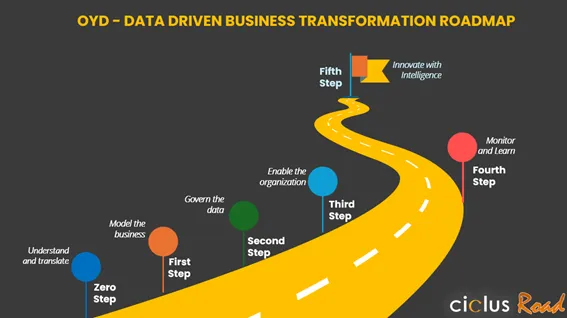
(Figure 1. Business Transformation Roadmap aligned to OYD Principles – Source: Ciclus Group)
The OYD roadmap represents a structured journey from data chaos to clarity, composed of five integrated stages:
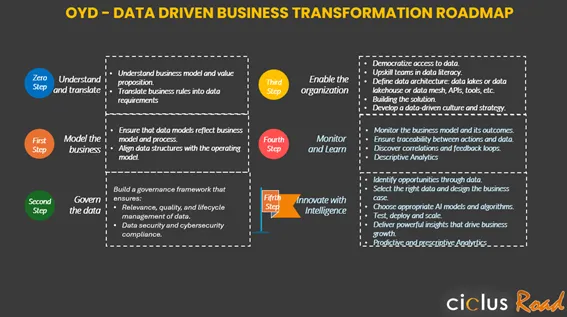
This roadmap ensures a continuous cycle of improvement and positions healthcare institutions to scale sustainably while placing the patient at the center.
The traditional healthcare model often treats patients as endpoints in a process — recipients of diagnoses, prescriptions, or results. OYD turns that model inside out.
By granting patients transparent access to their information, healthcare providers achieve three critical outcomes:
This approach reflects a growing global trend toward data democratisation in healthcare, where informed patients contribute to better outcomes, cost reduction, and stronger public health systems.
The lessons from the Peruvian mining case extend far beyond the Andes. Across the world, healthcare systems face similar challenges: fragmented data, rising costs, and the urgent need for predictive and preventive models.
By implementing OYD, healthcare organisations can achieve:
In the near future, patients will not just carry medical IDs, they will carry data passports, digital identities that connect them to a secure, integrated health ecosystem. OYD provides the blueprint for that future.
Own Your Data (OYD) represents more than a framework, it is a movement toward a more transparent, intelligent, and human healthcare system.
When patients own their data, they reclaim agency over their health. When clinics manage that data ethically and intelligently, they strengthen trust and deliver measurable impact. When technology aligns with governance and culture, healthcare becomes proactive, not reactive.
The transformation seen in the Peruvian mining sector is proof that even in complex environments, structured data strategies can deliver tangible human value.
As healthcare continues to evolve globally, the question is no longer if we should adopt a data-driven model, it is how fast we can make patients the true owners of their information.

Marita Huamán Peralta is a visionary leader in data-driven business transformation across Latin America. As CEO of Ciclus Group, she integrates analytics, data governance, and innovation to help organisations unlock growth, modernise operations, and generate strategic impact. Her mission is to transform complexity into clarity and empower institutions to fully own, trust, and elevate their data.