Medicaid expansion under Affordable Care Act (ACA) has gradually continued to redefine the healthcare system in the U.S, reducing the number of people without health cover while enhancing access and quality and overall enhancing the health of the population. It has helped in the development of state’s economy and financially strengthened rural hospitals. Still, if we look at the issues such as cost and the disinclination of the implementation that is still far from equal across the country, it is still a big leap towards better healthcare for all.

Although Medicaid is a federal statute for the health insurance of the needy and low income earners, its expansions have been influenced by the ACA signed in 2010. Law by law, act by act, one of the main features of ACA was an extension of medicaid through which it was planned to bring affordable health for millions of Americans. This effort has dramatically affected healthcare delivery and funding system throughout the United States in many areas of practice. So in this article, we will be looking at the evolution, advantages, limitations and future with regard to Medicaid expansion.
Medicaid was signed into law in 1965 to address the health needs of the poor needy persons including families; pregnant women; children; and the disabled among others. Previous to the ACA, Medicaid enrollment depended upon the state of residence and was limited to certain categories. Most of the low income earning adults who had no dependent children were neglected.
Thus, to reduce these gaps, the ACA permitted States to expand Medicaid to all Americans earning up to 138% of the federal poverty level (FPL). To many, for context, this is about $20,120 per year to an individual in the year 2023.” During expansion, the federal government was fully funding the program, but over time, contributed only 90% of the costs while states bearing the rest 10%.
Medicaid expansion was proposed for a national implementation but, in 2012 the Supreme Court severed it down to state implementation making the program have an inconsistent adoption across the United States.
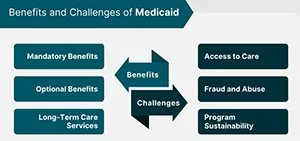
As much as highlighted above, increased healthcare coverage has been one of the main effects of Medicaid expansion within the shortest period.
In states that implemented the program, the number of people without access to health insurance has reduced, especially among the poor’s. This has enabled millions of people to get primary care, preventive services, as well as lifesaving care, that before they could not afford.
For instance, people suffering from conditions such as diabetes or hypertension daily are now in a better position to take their check-ups and medicine. It also contributes to avoiding new or additional diseases that may develop additional health consequences or additional costly admittances.
Moreover, expansion has been particularly beneficial for rural populations. Rural hospitals often serve low-income communities, and Medicaid expansion has provided them with a stable source of revenue, helping these facilities stay operational.
As mentioned earlier, Medicaid expansion has been particularly good for the rural people. Many rural hospitals have patients with low incomes, and Medicaid expansion has become a source of income that keeps these hospitals open.
It has also had economic impact on the states that expanded Medicaid. In the implementation of the program, the States adopting them have felt the effects of an expansion in the employment opportunities of the health sector because of the rising demand for medical services. It also supplies the government with tax revenues that a state uses to pay part of its Medicaid expenses.
Also, the federal monies that have accompanied the expansion have eased budget burden on the state and local government. For instance, the states have claimed reduced amounts of uncompensated care – these are the costs that hospitals incur in treating the uninsured. The money saved can then be used in other important sectors as for instance education and infrastructure.
Another revolutionary transformation associated with Medicaid expansion is that of the effect on health of the population. Some of the areas that expansion states reveal lower levels of are: The number of preventable deaths being lower in expansion states; maternal and infant mortality being lower in expansion states; diseases including cancer being detected early in expansion states.
For instance, people are now attending more checkups in a bid to know their status way ahead for instance cancer related test have led to early detections hence enabling early treatments. It has also lowered racial and ethnic minorities’ barriers to healthcare services’ access due to expansion.
Healthcare intervention has also received a facelift with improvements in the mental health, and substance use treatments. This expansion of Medicaid has funded coverage for behavioral health which tackled the opioid epidemic.
However, the expansion of Medicaid has not been without any hitch. There is however a primary disadvantage; cost. Despite the federal government’s assuming the central share of the cost, states also have to bear their own contribution which in many cases becomes extortionate and a burden to their budgets especially in less booming states.
The second problem of the strategy is its heterogeneity. To present, 10 states have declined the availability of Medicaid through expansion, leaving millions of the impoverished uncovered. This leads to a great unequal distribution of healthcare services across the states.
Thirdly, critics state that possibilities of expansion of Medicaid entice some people to look for a job or better paid job in order to be eligible for it. But research has indicated that the expansion clientele populates the lower wage jobs, and do not have affordable access to employer provided health insurance.
Real people’s experiences with Medicaid expansion give a richer depth to this fundamental legal and policy change. For instance, there is a young woman based in an expansion state who got prenatal care through the Medicaid program. This care meant she remained healthy for both herself and her baby with no development of complications that could have otherwise been fatal.
In another instance an opioid addicted man relying on Medicaid was able to get a treatment program that required a drastic change of his life. Without this support he could have been continue being locked up within his cycle of drug and alcohol addiction and a life of poverty.
The eventualities of the future of expansion of Medicaid are still unknown, however, the possibility looks bright. Advocates among the policymakers for the expansion continue campaigning for the adoption in the said non-expansion states, not to mention the gains economically and within the health sector. Federal programs may also launch new stimulus based on incentives of participation.
Such special provisions as their Medicaid waivers let the States adapt the parameters as per their requirements, such as including the work requirements or contemplating with explicit populations. Such approaches are useful as they assist in making that Medicaid expansion would work to different populations as planned.
Medicaid expansion and the relevance of Medicaid has been brought into question because of its impact towards health transformation as well as the economy across different facilities and regions in the United States. Despite this, the achievements presented would readily show that the program does work effectively towards the goal of establishing a healthier nation that eliminates disparities in health and nutrition. If other states join the list of those that want to adopt expansion, the expansion’s benefits may change the care system once more in the United States.
Medicaid expansion is not about numbers or policies – it is about people. It’s about giving a chance to those, who are often underestimated or forgotten, to become healthier and happier.

Debi Jones, part of the Editorial Team at American Hospital & Healthcare Management, draws on her deep experience in healthcare communication to produce clear and impactful content. Her dedication to simplifying intricate healthcare topics helps the team fulfill its goal of offering relevant and influential information to the international healthcare sector.