Hospital at Home (HaH) has transformed healthcare through patient home acute care delivery that generates financial savings and improves both patient experiences and hospital infection-related dangers. The Health at Home model matches the outcomes of standard hospital care for select medical conditions and implements telemedicine together with remote tracking systems and home delivered healthcare.
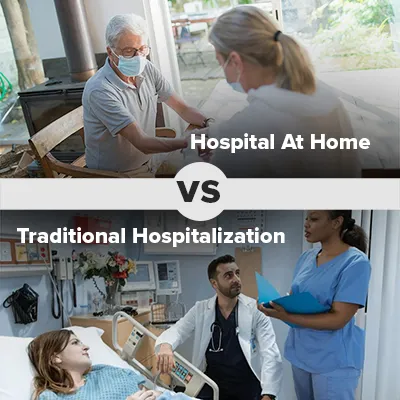
The healthcare industry continues to change significantly because new care delivery frameworks develop ways to make patients happier and cut expenses while producing better healthcare results. One innovative healthcare solution is Hospital at Home (HaH) that enables medical professionals to provide acute care services to patients inside their households. Traditional hospitalization stands as a baseline to evaluate how well the Hospital at Home model performs. The selection also needs evaluation based on how it impacts caregiver satisfaction levels and expenditure as well as medical results. This article examines the main dissimilarities together with benefits and obstacles that patients and healthcare providers encounter when deciding between hospital care and home care.
Hospital at Home represents a healthcare delivery approach that enables patients to access acute care from physicians in their residential setting via sophisticated telemedicine equipment and monitoring technologies and house-based medical services. The home healthcare structure function as a formal hospital-level system which provides care through critical home services together with emergency medicine and intensive care delivery.
The standard hospital care model requires patients to enter medical facilities to obtain non-stop medical care from specialists while receiving complex medical treatments. Hospitalization exists as the preferred method of treatment for critical and surgical situations but comes with multiple limitations including substantial expense and potential infections along with longer care delays.
| Feature | Hospital at Home | Traditional Hospitalization |
| Cost | Lower (reduced hospital overheads, fewer infrastructure costs) | Higher (bed charges, administration fees, facility maintenance) |
| Patient Satisfaction | Higher (comfortable, familiar environment) | Lower (stressful, noisy hospital setting) |
| Outcomes | Comparable or better for select conditions | Standardized high-quality care for critical conditions |
| Risk Factors | Fewer infections, lower exposure to hospital-acquired diseases | Higher risk of nosocomial infections, bedsores |
| Technology Dependency | High (telemedicine in home care, remote monitoring) | Moderate (direct physician care, minimal remote monitoring) |
| Family Involvement | Encouraged; family can participate in caregiving | Limited; restricted visiting hours |
| Suitability | Best for chronic disease home management, home recovery programs | Essential for severe trauma, surgeries, complex ICU care |
Key Benefits of Hospital at Home Care
1. Cost Savings
2. Better Patient Satisfaction
3. Improved Clinical Outcomes
4. Lower Risk of Hospital-Acquired Infections
5. Advanced Home-Based Healthcare Services
The benefits of Hospital at Home care collide with certain implementation difficulties.
| Cost Factor | Hospital at Home | Traditional Hospitalization |
| Daily Care Cost | Lower | Higher |
| Medical Equipment | Customized per patient | Shared hospital infrastructure |
| Nursing & Support Staff | Reduced visits, telemedicine support | 24/7 in-person monitoring |
| Room & Bed Charges | None | Expensive |
| Overall Cost Savings | 30-50% less than hospital stays | High cumulative expenses |

The implementation of telemedicine stands central to home-based medical care because it provides:
The HaH model continues to grow internationally since healthcare facilities seek affordable hospital alternatives to address their overcrowding problems. Modern developments in hospital-at-home technology together with telemedicine service delivery and home-based critical healthcare will drive the viability of these practices.
When providing at-home medical care for stable patients, the Hospital at Home model proves superior to standard hospitalization due to its cost-efficiency and enhanced patient welfare and care consistency. Patients with intensive treatment needs and advanced diagnosis requirements and complex surgery mandates should continue to use traditional hospital services.
A healthcare system based on home care and alternative hospital access units can provide the most desirable features of both methods while creating better and cost-effective medical outcomes.
Medical services extended at Home versus those administered inside traditional hospital facilities should compare their suitability rather than their superiority for patient treatment. Home healthcare services and telemedicine in home care and personalized acute care at home will transform patient treatment through more accessible affordable and effective healthcare delivery in the future of medical care.
Healthcare providers can provide high-quality patient-centered care which leads to better recovery results through their utilization of home-based medical care together with hospital at home technology and alternative hospital admission options.
.webp)
Kate, Editorial Team at American Hospital & Healthcare Management, leverages her extensive background in Healthcare communication to craft insightful and accessible content. With a passion for translating complex Healthcare concepts, Kate contributes to the team's mission of delivering up-to-date and impactful information to the global Healthcare community.