Immunotherapy vs. Traditional Therapies: A New Frontier in Healthcare

Debi Jones, Editorial Team, American Hospital & Healthcare Management

Immune therapy is a real innovation in the spheres of medicine that makes it possible to utilize action of the human immune system in the fight against tumor cells. It differs from the conventional treatments which comprises of chemotherapy, surgeries, and radiation and Advantages include: non-hormonal, possesses specific actions, prolonged durations of efficacy and lesser side effects. Though costly and not suitable for all, its future lies in personalized, combined treatments.
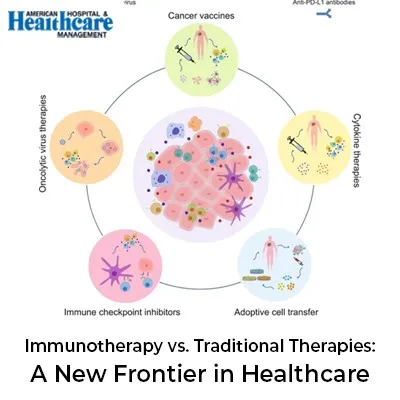
Infographic comparing immunotherapy with traditional cancer treatments.

Introduction:

Immunotherapy is now recognized as one of the greatest advances in the field of medicine and so offers the possibility of a cure for diseases which were previously considered to be incurable which is really a dream come true. While there had been application of ordinary treatments and curative measures like chemotherapy, radiation and surgeries which clinically have been in practice for many years in treating diseases such as cancer, immunotherapy is now extending the frontiers by using the body’s immune system. This article will briefly cover the immunotherapy and the normal therapies, the pros and the cons of immunotherapy as well as the prospects of the immunotherapy.

Traditional Therapies: What Are They?

Conventional medicine includes standard treatments such as operation, chemotherapy, and radiation within its catalog. These approaches have been employed in treatment of diseases including cancer for many years.

  1. Surgery: It includes the process that involves surgical procedure of taking out the tumor and other affected tissue through mechanical way. Even though it can be rather useful, surgery is used only for certain types of cancer, which are localized and does not consider secondary formations, with cancer cells that spread to other body parts. 
  2. Chemotherapy: Chemotherapy applies chemicals with a primary aim of eradicating quickly multiplying cancerous cells. But it is also toxic to normal cells, bringing such negative consequences as hair loss, fatigue, and nausea. It remains useful in many instances, though it is not always sufficing to preclude the return of the cancer. 
  3. Radiation Therapy: There is the use of radiation energy to kill cancerous cells through this method. Similar to chemotherapy, radiation therapy is also damaging to normal as well as cancerous cells thus likely to cause effects like skin burns and fatigue.

Immunotherapy: A New Approach

While other therapies target cancer cells and tumors themselves, immunotherapy is a companion to the immune system of the body in seeking out and eradicating cancer cells. Apparently, our immune system is protective of us, especially against infections and diseases but sometimes some cells turn into cancer cells. Immunotherapy enhances the immune system ability to identify and destroy such invisible malignant cells out there.

There are several types of immunotherapies, including:

  1. Checkpoint Inhibitors: It enables patients’ immune systems to find cancer through ‘hiding’ protein that prevents the immune system to target cancerous cells.
  2. CAR-T Cell Therapy: One is when T cells which are one of the five major classes of human immune cells are modified in a way in a lab to be in a position to identify and dislike cancerous cells. They are then altered and are reintroduced into the patient’s circulation in order to detect cancer cells and to destroy them. 
  3. Vaccines: So the fact was that while we usually associate a vaccine with prevention, there are so-called therapeutic or oncological vaccines meant to encourage the immune system to affect cancer cells. 

Advantages of Immunotherapy

Immunotherapy has several potential advantages over traditional therapies:
  1. Targeted Action: Immunotherapy is much targeted and generally aims at enhancing the immune system to identify cancerous cells and destroy them and most patients are always in a position to endure minimal side effects as compared to those who undergo chemotherapy and radiation. This is because the immune system is naturally created to defend the body which makes it avoid healthy cells.
  2. Long-lasting Results: Unlike chemotherapy, immunotherapy helps the body to keep protecting the patient even after the sessions are over in some cases. Several white blood cells are said to have the ability to memorize cancer cells so they can fight off any further incursion by the disease hence avoiding relapse. 
  3. Effectiveness in Advanced Cancers: Unlike conventional therapies, targeted therapies may fail in handling cancers that spread to different organs, but immunotherapies have the potential to address progressive and metastatic cancer types.

Challenges of Immunotherapy

Despite its potential, immunotherapy is not without challenges:

  1. Not Suitable for All Patients: Like any other treatments, immunotherapy may be helpful to some patients but not to all. The treatment may not be effective in some patients and researchers have not yet establish what causes this. 
  2. Side Effects: However, immunotherapy is still associated with fewer side effects than chemotherapy and these include; fatigue, change in the skin, and flu-like symptoms. At times, the immune system can become sensitized to the body’s natural tissues and function and actually destroy these structures.
  3. Cost: The use of self-administrative immunotherapy is usually expensive compared to the conventional forms of treatment. Unfortunately, often these treatments are expensive and not offered in many centers which can prevent some patients from receiving such proper treatment and benefiting from the new approach. 

The Future of Immunotherapy and Traditional Therapies

Until the research is complete, it is entirely possible that a future in which immunotherapy and conventional medical treatments coexist in health care will become a reality. Still, in some cases, doctors are not using combined therapy and address only one of these aspects to enhance the result. For instance, a client may be treated surgically for a tumor removal then proceed to immunotherapy to eradicate possible reoccurrence. Like treatment based on the client’s unique genetic makeup and the disease type, trends of developing personal medication are also gaining popularity. 

The goal for now is that immunotherapy will be developed to serve as effective drugs for different forms of cancer at initial stages as standalone treatment or possibly in combination with other therapies. New approaches also exist with new technology and new understandings of the genetic base of illnesses.

Conclusion:

Immunotherapy is one of the most promising fields in the modern healthcare, being a potentially effective treatment for diseases that other treatments cannot solve. Both immunotherapy and traditional therapies have their disadvantages but the solution of course is to provide the best treatment possible which is perhaps to incorporate both systems. With time, research is opened up to even more developments in combating diseases such as cancer; meaning more patient flying better results and even enhanced quality life.

 

Debi Jones

Debi Jones, part of the Editorial Team at American Hospital & Healthcare Management, draws on her deep experience in healthcare communication to produce clear and impactful content. Her dedication to simplifying intricate healthcare topics helps the team fulfill its goal of offering relevant and influential information to the international healthcare sector.


Healthcare CFO - Financial Strategy & Revenue Cycle Summit Healthcare CEO & Executive Strategy Summit